A Pillow Guide: Matching Pillow Type to Sleep Position
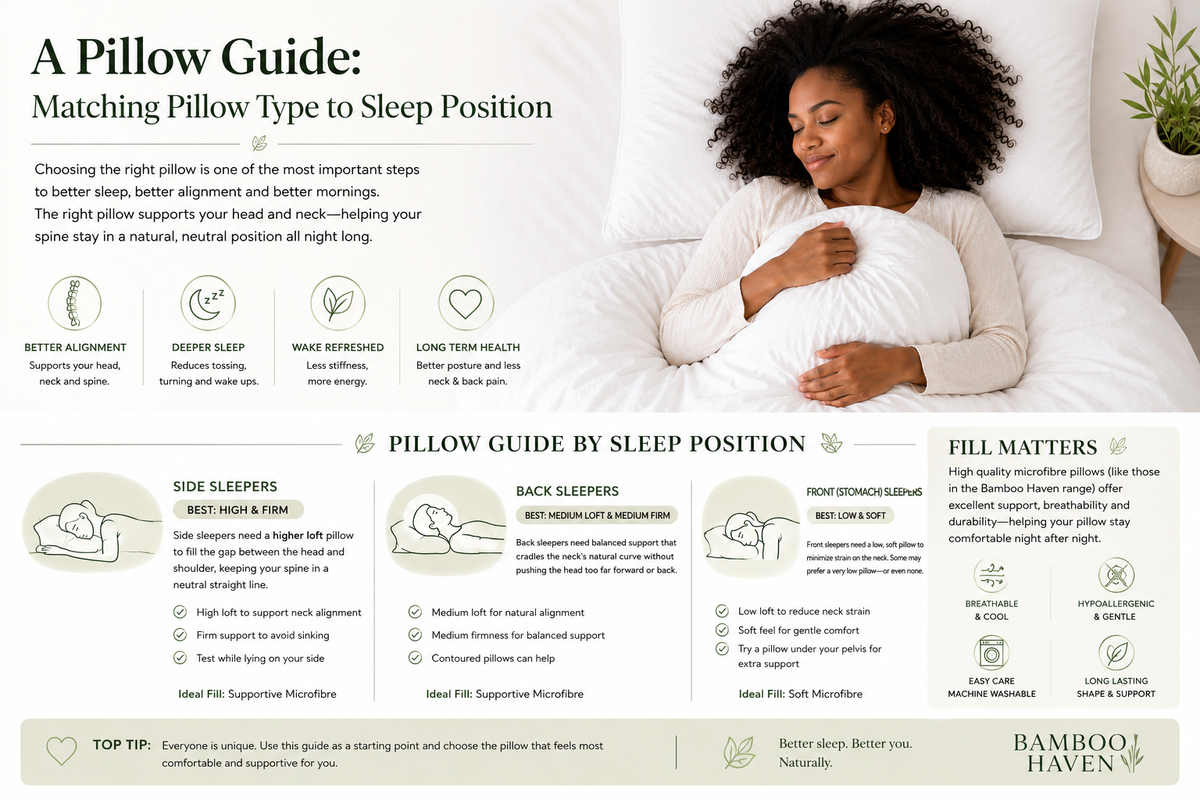
Choosing the right pillow is one of the more genuinely consequential bedding decisions for both sleep quality and neck and spine health, yet it is frequently treated as an afterthought compared with the attention given to mattresses and duvets. Matching pillow height, firmness and fill to your predominant sleep position makes a meaningful, often immediately noticeable difference to overnight comfort and how you feel upon waking.
Why Sleep Position Should Drive Pillow Choice
The core principle behind good pillow selection is spinal alignment: a well-chosen pillow supports the head and neck in a position that keeps the spine in a genuinely neutral alignment throughout the night, avoiding the kind of awkward angling that can contribute to neck stiffness, shoulder discomfort or disrupted sleep. Since different sleep positions place the head and neck at different natural angles relative to the mattress, the ideal pillow height and firmness genuinely differs by position, which is why a single pillow type rarely suits every sleeper equally well.
Pillows for Side Sleepers
Side sleeping is the most common sleep position among UK adults, and it places the greatest distance between the mattress surface and the natural resting position of the head, since the shoulder itself occupies significant space between the head and the mattress. This means side sleepers generally need a genuinely firmer, higher-loft pillow than other sleep positions, filling that gap sufficiently to keep the neck in a neutral, straight alignment with the rest of the spine, rather than allowing the head to tilt downward toward the mattress or prop upward at an unnatural angle.
A pillow that is too flat for side sleeping allows the neck to bend downward toward the shoulder, while a mismatched, overly soft pillow can compress under the head’s weight during the night, gradually losing the support it initially appeared to offer. Side sleepers specifically benefit from testing a pillow’s firmness while actually lying in their genuine sleep position, rather than judging firmness while sitting upright or lying on their back, since the pillow’s performance can feel meaningfully different across these different positions.
Also Read: What Is Bamboo Viscose? Everything You Need to Know About This Luxury Fabric
Pillows for Back Sleepers
Back sleeping places the head in a more central, less elevated position relative to side sleeping, generally calling for a medium-loft, medium-firmness pillow that supports the natural curve of the neck without pushing the head too far forward, which can happen with an overly thick or firm pillow, or allowing the head to tilt too far back, which can happen with a pillow that is too thin or too soft. Many back sleepers find a slightly contoured pillow, offering a touch of extra support specifically under the neck’s natural curve, particularly comfortable, though a well-filled, evenly supportive standard pillow works well for many back sleepers too.
Back sleepers should also pay attention to lower back support more broadly, since a mismatched or unsupportive mattress can affect overall spinal alignment in ways a pillow alone cannot fully correct, meaning pillow choice is best considered as one part of an overall supportive sleep setup rather than the sole determining factor for back sleepers specifically.
Pillows for Front (Stomach) Sleepers
Front sleeping is generally considered the position requiring the most caution around pillow height, since a pillow that is too thick can force the neck into an uncomfortable, twisted angle for extended periods, given that front sleepers typically turn their head to one side rather than sleeping face-down directly into the pillow. Front sleepers generally benefit from the thinnest, softest pillow among the three main sleep positions, sometimes even sleeping with a very low-loft pillow or, for some people, no pillow under the head at all, occasionally supplemented instead with a thin pillow under the lower abdomen to support spinal alignment from below rather than from the head and neck.
It is worth noting that front sleeping is generally considered less favourable for spinal alignment than side or back sleeping by many physiotherapists and sleep specialists, and anyone experiencing regular neck or back discomfort who sleeps predominantly on their front may wish to discuss sleep position more broadly with a healthcare professional, alongside making pillow adjustments.
Pillow Fill and Its Effect on Support
Beyond height and firmness, fill type affects how a pillow feels and performs over time. Microfibre-filled pillows, such as those used throughout the Bamboo Haven pillow range, offer a supportive, evenly distributed loft that holds its shape well through the night, combined with a genuinely soft, huggable feel that many people find more comfortable than firmer alternatives such as memory foam. A bamboo viscose pillow cover adds breathability directly against the skin and hair, reducing the heat buildup that can occur with less breathable pillow cover fabrics, which matters particularly for anyone who runs warm overnight or experiences night sweats, as discussed in our dedicated guide on that topic.
Combination Sleepers: Choosing for Versatility
Many people are not exclusively a single-position sleeper, shifting between side, back and occasionally front positions across a single night. For combination sleepers, a medium-firm, medium-loft pillow that performs reasonably well across multiple positions, rather than being optimised extremely specifically for one position alone, generally offers the best practical all-round comfort, even if it may not be the theoretically perfect match for any single position in isolation.
Signs Your Current Pillow Isn’t Right for You
A number of practical signs suggest a pillow may not be well matched to your sleep position or needs: regularly waking with neck stiffness or discomfort, frequently repositioning or flipping the pillow through the night in search of a more comfortable spot, or a pillow that has visibly flattened or lost its original supportive loft over time. Pillows generally have a genuine practical lifespan — typically one to two years for consistent, correct support — after which replacement, rather than continuing to adjust position around a degraded pillow, tends to resolve ongoing discomfort more effectively.
Pillow Care and Maintenance
Extending a pillow’s genuinely supportive lifespan involves more than simply choosing the right type initially. Regular washing of pillowcases, as discussed in our dedicated washing frequency guide, protects the pillow itself from excessive direct soiling, while periodically fluffing and reshaping pillows helps redistribute fill material that can otherwise settle and compact unevenly over time, particularly for microfibre-filled pillows that benefit from this occasional redistribution to maintain even, consistent loft across the full pillow surface. Airing pillows outside their cases periodically, when weather and practicality allow, also helps manage moisture and freshness in the fill material itself, beyond what pillowcase washing alone addresses.
Travel Pillows and Away-From-Home Considerations
For anyone who travels regularly and notices their sleep quality suffering while away from their own carefully chosen pillow, a compact, well-matched travel pillow suited to their genuine sleep position, rather than relying entirely on whatever pillow happens to be provided, can meaningfully reduce the sleep disruption travel often causes. This is a particularly worthwhile consideration for side sleepers specifically, given how significantly an unfamiliar, potentially mismatched pillow height can affect neck alignment and comfort compared with back or front sleepers, who tend to be somewhat more adaptable to pillow variation between their own bed and unfamiliar sleep environments.
Give Yourself Permission to Experiment
Finding your genuinely ideal pillow sometimes takes a small amount of trial and adjustment, and this is entirely normal rather than a sign you are doing something wrong. If a pillow that seemed right in principle does not feel genuinely comfortable after a fair trial period of a week or two, trusting that feedback and adjusting height, firmness or fill type accordingly is a perfectly reasonable, expected part of finding the right long-term match for your specific sleep position and body.
Pillow Height Adjustability
Some pillows are designed with removable or adjustable fill, allowing loft to be customised beyond the standard fixed options discussed throughout this guide. For anyone who finds themselves consistently between two standard loft options, or whose needs have changed over time, an adjustable pillow can offer a genuinely useful degree of ongoing customisation without needing to purchase an entirely new pillow each time preferences shift.
Frequently Asked Questions
Q1: How many pillows should I actually sleep with?
Ans: This depends on personal preference and sleep position, but for spinal support purposes, one well-matched pillow correctly suited to your predominant sleep position is generally sufficient; additional pillows are more a matter of personal comfort preference than a genuine support requirement.
Q2: Should I use a different pillow if I have neck pain?
Ans: Persistent neck pain is worth discussing with a GP or physiotherapist, who can advise on whether pillow adjustment, alongside other factors such as mattress support and general posture, may help; a well-matched pillow for your sleep position is a sensible starting point but is not a substitute for professional advice if pain persists.
Q3: How often should pillows be replaced?
Ans: Most pillows benefit from replacement every one to two years, since fill materials gradually lose their original supportive loft through regular use and washing, even when the outer pillowcase itself remains in good condition.
Matching your pillow to your genuine, predominant sleep position — rather than choosing based on softness preference or price alone — is a simple, often overlooked step that can make a genuinely meaningful difference to both immediate overnight comfort and longer-term neck and spine health.