Fitted Sheet vs Flat Sheet: Do You Need Both?
The question of whether a flat “top” sheet is genuinely necessary alongside a fitted sheet and duvet cover has become a surprisingly common bedding debate, with genuinely reasonable arguments and preferences on both sides. Understanding what each type of sheet actually does, and the practical trade-offs involved, helps you decide what genuinely works best for your own bed rather than simply following whichever convention you grew up with.
What a Fitted Sheet Does
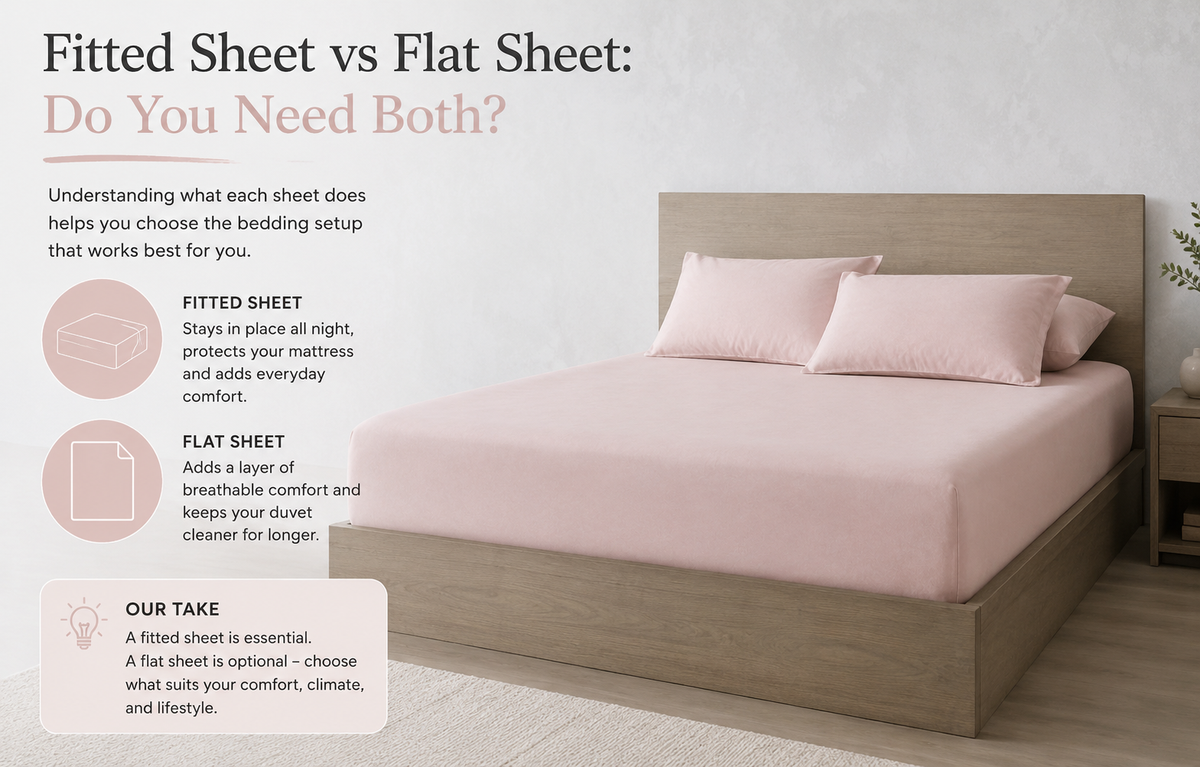
A fitted sheet, with its elasticated corners designed to wrap securely around the mattress, provides the primary layer of protection between you and the mattress itself, and is genuinely essential in virtually every bedding setup. It protects the mattress from body oils, sweat and general wear, while providing a smooth, comfortable surface for direct skin contact. There is very little genuine debate about whether a fitted sheet is necessary — it is close to a universal bedding essential, differing only in fabric choice and, as discussed in our dedicated sizing guide, correct pocket depth for your specific mattress.
What a Flat (Top) Sheet Traditionally Does
A flat sheet, traditionally placed between the sleeper and the duvet or blanket, serves a somewhat different purpose: it protects the duvet cover and duvet itself from more direct body contact, theoretically extending the interval needed between washing the bulkier duvet cover, since the more frequently washed flat sheet takes on more of the direct sweat and skin contact instead. In many traditional and hotel-style bedding setups, particularly in the United States, the flat sheet also functions as the primary covering during warmer nights, used alone without a duvet or blanket layered on top.
Also Read: The Complete Sleep Hygiene Guide for UK Adults: Build Better Sleep Habits Tonight
The Case for Using a Flat Sheet
Advocates for continuing to use a flat sheet point to a genuine practical benefit: a flat sheet is generally quicker and easier to wash and dry than a full duvet cover, given its simpler, flatter shape without the bulk of an enclosed duvet cover, meaning washing the flat sheet more frequently — capturing more of the direct sweat and skin contact before it reaches the duvet cover — can be a genuinely practical, lower-effort way to maintain overall bedding freshness between full duvet cover washes. Flat sheets also offer additional temperature flexibility, providing a lighter single-layer covering option for particularly warm nights without needing to fully remove and store the duvet.
Some people also simply prefer the specific feel of a flat sheet directly against the skin, distinct from the feel of a duvet cover, particularly if their duvet cover fabric differs from their preferred flat sheet fabric.
The Case Against Using a Flat Sheet
Critics of the flat sheet convention, a growing group in the UK bedding market, point out several genuine practical drawbacks. Flat sheets frequently become tangled, twisted or displaced during the night, particularly for restless sleepers, often ending up bunched at the foot of the bed by morning rather than providing the smooth, even coverage intended. Making a bed with a flat sheet involves genuinely more time and effort than simply using a duvet and cover alone, requiring careful tucking and smoothing to achieve a neat result, connecting back to the bed-making habit discussed in our dedicated psychology guide, where ease of the habit itself supports its consistency. For many modern UK households, particularly those with a genuinely breathable, well-cared-for duvet cover fabric such as bamboo viscose, the duvet cover itself already provides sufficient direct-contact comfort and freshness management without needing an additional flat sheet layer.
A Genuinely Practical Middle Ground
For many UK households, the practical answer has increasingly become using a fitted sheet and duvet cover as the core, everyday setup, with a flat sheet reserved as an optional addition for specific situations — layered in during particularly cold weather for extra warmth, or used alone without the duvet during a genuine summer heatwave, as discussed in our dedicated layering guide. This approach captures the genuine situational benefits a flat sheet offers without committing to the additional daily bed-making effort and tangling frustration for every single night of the year.
What This Means for Washing Frequency
If you choose to forgo a flat sheet as part of your everyday setup, it becomes particularly important to follow the washing frequency guidance in our dedicated care guide closely for your duvet cover specifically, since it will be taking on more direct, sustained skin contact than in a setup where a flat sheet provides an additional buffer layer. Washing the duvet cover weekly to fortnightly, rather than allowing longer intervals between washes, helps maintain genuine freshness and hygiene in a flat-sheet-free setup.
Personal Preference Ultimately Decides
Ultimately, there is no single objectively correct answer to the fitted-sheet-versus-flat-sheet question — it comes down to a genuine trade-off between the additional temperature flexibility and washing convenience a flat sheet offers, against the additional bed-making effort and tangling frustration some people experience with one. Trying both approaches for a meaningful period — a few weeks with, and a few weeks without — is a genuinely practical way to determine your own preference, rather than assuming either convention is automatically correct for your specific household and sleep habits.
How Duvet Cover Quality Affects This Decision
The specific quality and breathability of your duvet cover fabric genuinely affects how compelling the case for skipping a flat sheet actually is. A lower-quality or less breathable duvet cover fabric may feel noticeably less pleasant against bare skin compared with a genuinely soft, breathable bamboo viscose duvet cover, making a flat sheet feel more like a comfort necessity to buffer against a less pleasant direct-contact fabric. With a genuinely high-quality, smooth and breathable duvet cover, many people find the direct-contact experience comfortable enough on its own that a flat sheet starts to feel like an unnecessary additional layer rather than a genuine comfort improvement, which is part of why the flat sheet convention has become somewhat less universal as quality duvet cover fabric options have improved.
International Differences in Flat Sheet Convention
It is worth noting that flat sheet convention varies considerably by country and culture, with some regions treating a flat sheet as an almost universal bedding essential, while others have long favoured duvet-and-cover-only setups without much cultural expectation of an additional flat sheet layer. The UK sits somewhat in the middle of this spectrum, with flat sheet use remaining common in many households while duvet-and-cover-only setups have become increasingly normalised and widely accepted, meaning there is genuinely no single “correct” UK convention to feel obligated to follow either way.
Trying Both Before Committing Either Way
If you have never seriously considered life without a flat sheet, or conversely have never given one a proper try, this is a genuinely low-cost experiment worth running for yourself. A few weeks living with each approach will tell you far more about your own genuine preference than any general guide, including this one, ever could.
What Guests Might Expect
If you are deciding on a household-wide convention, it is worth considering that guests, as discussed in our dedicated guest room guide, may have their own expectations shaped by their usual home setup. Having a flat sheet available for guest rooms specifically, even if your own everyday bedroom setup goes without one, offers a simple way to accommodate differing guest expectations without needing to change your own household’s everyday preference.
The Choice Is Genuinely Yours
There is no bedding authority mandating one correct answer here — only your own comfort, convenience and preference should ultimately decide which approach earns a permanent place in your bedroom.
No Wrong Answer Here
Whichever way you land, know that plenty of genuinely happy sleepers exist on both sides of this particular bedding debate.
A Small Decision, Made Simple
What started as a seemingly small bedding question ultimately comes down to a straightforward trade-off between warmth flexibility and daily convenience, one only you can weigh for your own life.
Frequently Asked Questions
Q1: Is it considered hygienically necessary to use a flat sheet?
Ans: No — provided the duvet cover and fitted sheet are washed at an appropriately regular frequency, as discussed in our dedicated washing guide, forgoing a flat sheet does not create a genuine hygiene issue; it simply shifts more of the direct-contact washing responsibility onto the duvet cover itself.
Q2: Can I use a flat sheet with any duvet cover, or do they need to match?
Ans: A flat sheet does not need to precisely match your duvet cover in fabric or colour, though many people do prefer a coordinated look; functionally, any correctly sized flat sheet for your specific bed size will work regardless of your duvet cover choice.
Q3: Do hotels always use flat sheets, and should I follow that convention at home?
Ans: Many hotels do use flat sheets as part of their traditional bedding convention, partly for the practical laundering reasons discussed in this guide, given the very high turnover and washing frequency hotel bedding requires; this convention does not automatically need to be replicated at home, where washing frequency and personal preference differ considerably from a commercial hotel laundry operation.
Whether a flat sheet earns a permanent place in your bedding setup or becomes an optional seasonal addition ultimately comes down to your own genuine preference for warmth flexibility versus bed-making simplicity — there is no single right answer, only the setup that genuinely works best for how you sleep.