The Complete Sleep Hygiene Guide for UK Adults: Build Better Sleep Habits Tonight
Sleep hygiene is one of the most commonly recommended interventions for poor sleep — and one of the most commonly misunderstood. It is not about cleanliness or rituals for their own sake. Sleep hygiene refers to the specific habits, behaviours, and environmental conditions that the science of sleep tells us promote consistent, high-quality rest. When applied together and consistently, these principles have a profound effect on how quickly you fall asleep, how deeply you sleep, and how rested you feel when you wake.
This guide covers the complete picture — environment, routine, daytime habits, and the role of bedding — giving you everything you need to build a sustainable sleep practice.
Why Sleep Quality Matters More Than You Might Think
Most UK adults are familiar with the recommendation to get seven to nine hours of sleep per night. But the science is increasingly clear that the quality of that sleep matters at least as much as the duration. A person who spends eight hours in bed but experiences fragmented, shallow sleep — repeatedly disturbed by noise, temperature changes, or discomfort — may be significantly worse rested than someone who sleeps soundly for six and a half hours.
Deep sleep and REM sleep are the most restorative stages, associated with physical recovery, immune function, memory consolidation, emotional regulation, and cognitive performance. Anything that prevents you from reaching or sustaining these stages — whether environmental, behavioural, or physiological — affects your waking life in measurable ways that accumulate over days, weeks, and months.
Foundation One: Your Sleep Environment
Temperature
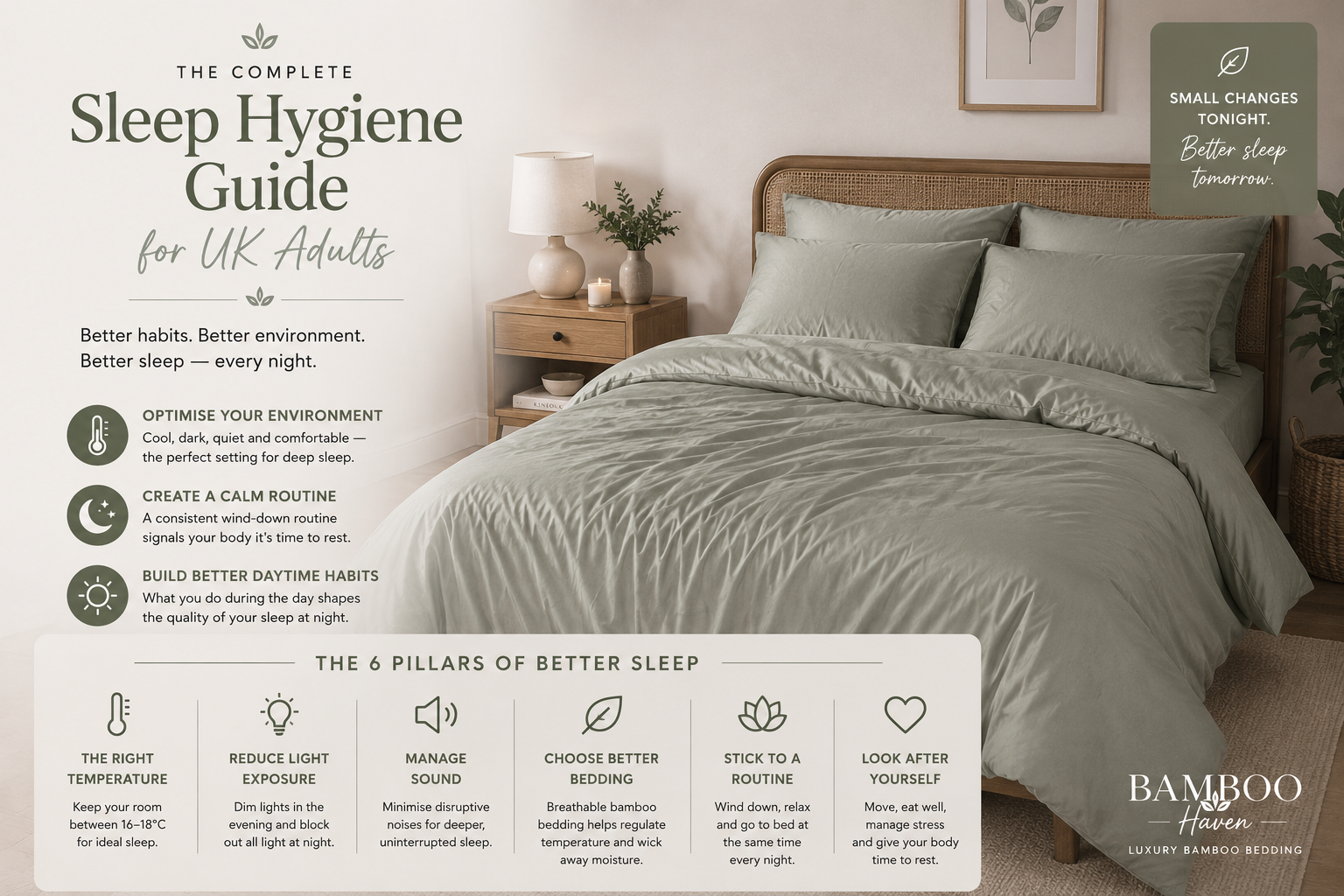
The ideal bedroom temperature for sleep is between 16 and 18 degrees Celsius. The body must drop its core temperature by approximately one degree Celsius to initiate sleep, and maintaining this cooler temperature through the night is essential for deep sleep continuity. Most UK bedrooms, particularly during spring and summer, exceed this range. Breathable bedding is one of the most effective compensating strategies. Bamboo Haven's 100% bamboo viscose bedding promotes continuous airflow through its fibre structure, helping the body regulate temperature naturally through the night — staying cool in summer and comfortable in winter without any active adjustment from you.
Light Control
Light is one of the most powerful regulators of the human circadian rhythm. Even small amounts of light — from street lighting, standby LEDs, or early morning dawn in summer — suppress melatonin production and can fragment sleep, particularly in the lighter sleep stages of the early morning. Invest in high-quality blackout curtains or blinds, ensure they overlap generously at the edges, and eliminate all light sources within the bedroom including standby indicator lights on televisions and chargers.
Sound Management
Sudden, unpredictable sounds are the most disruptive to sleep — more so than consistent background noise. Traffic, neighbours, or a partner's movement can cause brief arousal from sleep even without fully waking you, fragmenting your sleep cycles without your awareness. A white noise machine, a fan on a low setting, or earplugs can all help create a more consistent acoustic environment. Heavy curtains also absorb external sound to a meaningful degree.
Bedding
Your bedding creates the microenvironment in which your body spends the night. It affects temperature, moisture, allergen exposure, and physical comfort — all simultaneously, all night long. Bamboo Haven's bedding range is designed specifically to support optimal sleep conditions: breathable, hypoallergenic, moisture-wicking, and silky soft against the skin. The OEKO-TEX Standard 100 certification means you can be confident the fabric is free from harmful substances that might affect sleep quality or skin comfort over time.
Foundation Two: Your Pre-Sleep Routine
A consistent pre-sleep routine tells the nervous system that sleep is approaching. The most effective routines begin 60 to 90 minutes before the intended sleep time and follow the same sequence each night. Over time, this sequence becomes a reliable trigger for the physiological changes associated with sleep onset.
- Set a consistent sleep time and wake time — including weekends. The circadian rhythm is anchored by consistency above almost anything else.
- Dim lights in the hour before bed. Bright overhead lighting suppresses melatonin; use lamps or candles instead.
- Eliminate screens 45 to 60 minutes before sleep. Blue light from phones and tablets is disproportionately effective at suppressing melatonin even at low brightness levels.
- A warm shower or bath 60 to 90 minutes before bed facilitates the natural drop in core temperature associated with sleep onset.
- Use the bed only for sleep and intimacy — not for working, scrolling, or watching television. This strengthens the mental association between the bedroom and sleep.
- If you cannot sleep after 20 minutes, leave the bedroom and do something calm in dim light until you feel sleepy. Lying awake frustrated builds an unhelpful association between the bed and wakefulness.
Foundation Three: Daytime Habits That Shape Night-time Sleep
Caffeine Timing
Caffeine has a half-life of approximately five to seven hours in most adults, meaning that a coffee consumed at 3pm still has half its stimulating effect present in your system at 8 or 9pm. For most people, avoiding caffeine after midday is the safest approach for undisrupted sleep. This includes tea, many soft drinks, pre-workout supplements, and some over-the-counter medications.
Morning Light Exposure
Getting natural daylight within the first hour of waking is one of the most powerful tools for anchoring your circadian rhythm and promoting earlier, more reliable melatonin production in the evening. Even on overcast UK mornings, outdoor light is approximately 10 times brighter than typical indoor lighting. Ten to fifteen minutes outside — ideally without sunglasses — is sufficient to have a meaningful positive effect on your sleep that same night.
Exercise
Regular physical exercise consistently improves sleep quality, increases slow-wave deep sleep, and reduces the time it takes to fall asleep. However, vigorous exercise raises cortisol and core body temperature, both of which delay sleep onset if exercise happens within two to three hours of bedtime. Morning or early afternoon exercise produces the greatest sleep benefit for most people.
Alcohol
Alcohol is widely used as a self-prescribed sleep aid, but the evidence against this is overwhelming. While it does promote initial drowsiness, alcohol disrupts sleep architecture significantly, suppressing REM sleep, increasing sleep fragmentation, and raising body temperature in the second half of the night. Regular alcohol use before bed leads to chronic poor sleep quality even when sleep duration appears normal on the surface.
When Good Sleep Hygiene Is Not Enough
Sleep hygiene is highly effective for the majority of adults with poor sleep habits, but it is not a treatment for clinical sleep disorders. If you have applied these principles consistently for several weeks without significant improvement, it is worth speaking to your GP. Conditions including obstructive sleep apnoea, restless legs syndrome, clinical insomnia, anxiety, and depression all affect sleep quality significantly and may require specific treatment beyond lifestyle and environment changes.
The Role of Bedding in Sustainable Good Sleep
Effective sleep hygiene creates the conditions for deep, restorative sleep — and the right bedding is one of the foundational elements of those conditions. Bamboo Haven's bamboo viscose bedding supports sleep hygiene by maintaining a cool, breathable, hypoallergenic sleep surface that stays comfortable throughout the night. It is not a miracle solution, but it is one of the highest-impact environmental changes you can make — one that works every night, across every season, without requiring any active effort from you once it is on the bed.
Sleep Hygiene for Shift Workers and Irregular Schedules
Much of standard sleep hygiene advice assumes a conventional daytime working pattern, which leaves shift workers and anyone with an irregular schedule uncertain how to apply these principles to their own circumstances. The core logic still applies, just anchored to a different window: consistency remains the priority, meaning shift workers benefit from keeping their sleep and wake times as stable as possible around their actual working pattern, even when that pattern falls outside conventional daytime hours.
Light management becomes even more important for shift workers sleeping during daylight hours, making genuinely effective blackout curtains or blinds a near-essential investment rather than an optional upgrade. Eye masks provide a further layer of light control, particularly useful for those without full blackout capability in every room they might sleep in. Caffeine timing also needs to be recalculated relative to the individual's own sleep window rather than the conventional daytime schedule assumed in most general sleep hygiene advice.
Building Sustainable Habits, Not Perfect Ones
One of the most common reasons people abandon sleep hygiene improvements is attempting to implement every recommendation simultaneously and finding the full programme unsustainable within a busy, realistic life. A more effective approach is to introduce one or two changes at a time, allow them to become genuinely established habits over several weeks, and then layer in further improvements gradually. Bedding is a particularly good starting point precisely because it requires no ongoing daily discipline once the initial purchase is made — unlike screen habits or caffeine timing, which demand continuous, active choices every single day.
This is part of why upgrading to genuinely breathable, temperature-regulating bedding such as Bamboo Haven's bamboo viscose range is often recommended as an early step in any sleep hygiene improvement plan: it delivers a meaningful, passive benefit every night from the point of purchase onward, providing a stable foundation while other, more behaviourally demanding habits are gradually built on top.
It is also worth accepting, realistically, that the occasional off night is normal and not a sign that your sleep hygiene efforts have failed. Consistency over weeks and months is what shapes long-term sleep quality — not perfect adherence to every principle on any single night.
Build your ideal sleep environment with Bamboo Haven at https://bamboohaven.co.uk