The Best Bedding for Menopause: Managing Night Sweats with Bamboo
Night sweats are among the most commonly reported and most disruptive symptoms of menopause and perimenopause. For many women, they are not an occasional inconvenience but a nightly disruption that significantly affects sleep quality, daytime mood, concentration, and overall wellbeing. While medical treatments including hormone replacement therapy are effective for many women, practical strategies for managing night sweats in the sleep environment can make a substantial difference — and the right bedding is one of the most impactful, most immediate changes available.
Understanding Night Sweats During Menopause
Night sweats — medically referred to as nocturnal hyperhidrosis when occurring during menopause — are caused by the effect of declining oestrogen levels on the hypothalamus, the region of the brain responsible for regulating body temperature. As oestrogen fluctuates and eventually declines, the hypothalamus becomes more sensitive to small changes in core body temperature, triggering a heat-release response — a hot flush — even when the body is not genuinely overheated.
During sleep, this response manifests as sudden, sometimes intense sweating, rapid heart rate, and a feeling of intense heat that can last from a few seconds to several minutes. Many women experience multiple episodes per night, and the disruption to sleep architecture — particularly the fragmentation of deep sleep and REM sleep — accumulates into significant sleep deprivation over time, with wide-ranging effects on cognition, emotional regulation, and physical health.
Perimenopause, the transitional period that can begin years before the final menstrual period, typically involves the most variable and unpredictable hot flush and night sweat patterns. This phase can last from a few months to more than a decade, making the management of sleep environment not just helpful but essential.
How Bedding Affects the Experience of Night Sweats
Bedding cannot prevent a hot flush or night sweat from occurring. What it can dramatically affect is how disruptive the episode is and how quickly you can return to comfortable sleep afterwards. Bedding that traps heat amplifies the subjective experience of overheating during an episode. Bedding that retains moisture — leaving you lying in damp sheets — keeps the body in a state of discomfort long after the flush has passed, significantly delaying return to sleep. Bedding that actively manages both heat and moisture creates a very different experience: the flush is less aggravated, moisture is wicked away rapidly, and the body returns to a comfortable temperature more quickly.
Why Bamboo Viscose Is Particularly Well-Suited to Menopause
Exceptional Moisture Wicking
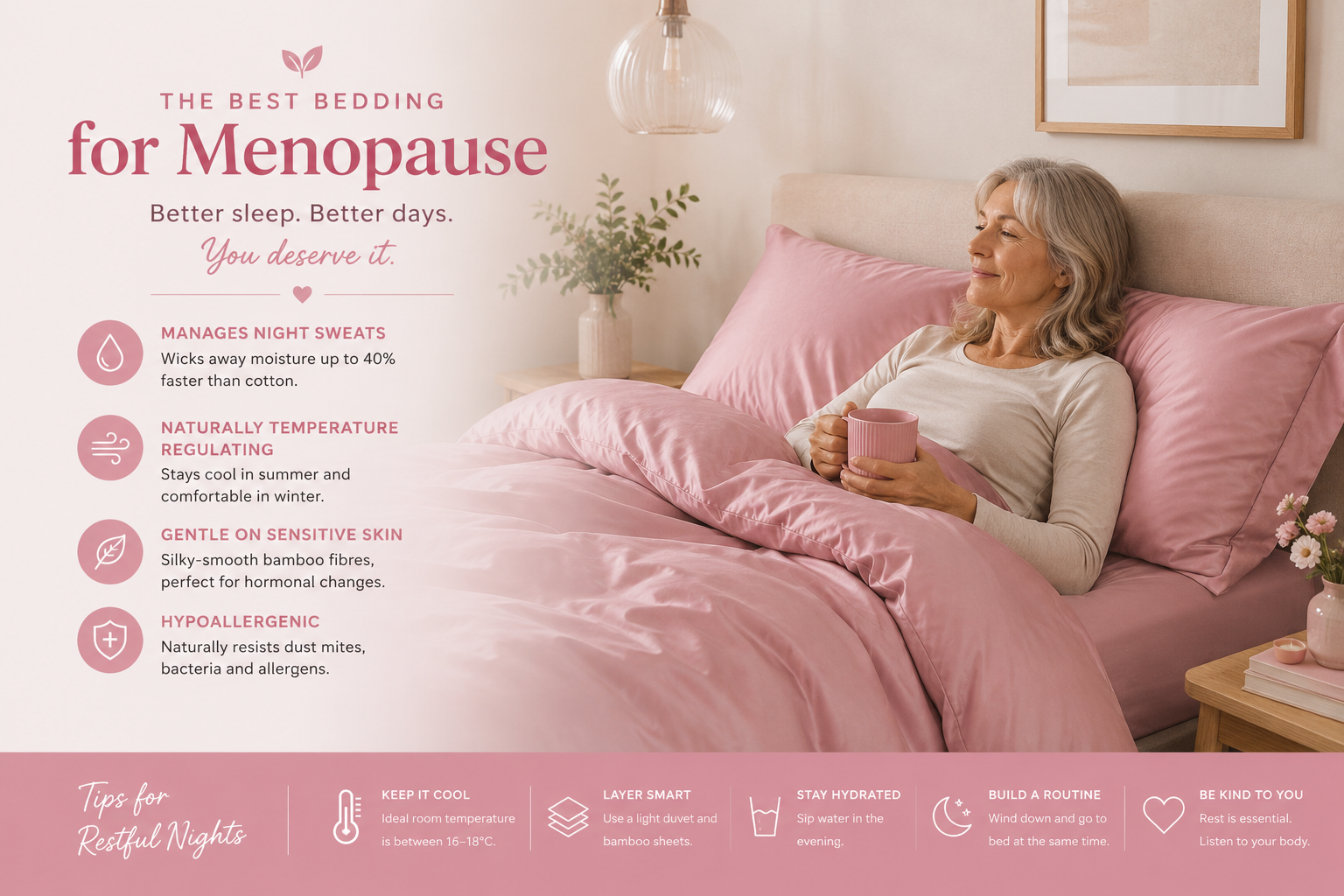
Bamboo viscose absorbs and disperses moisture significantly faster than cotton. During a night sweat, this means the fabric pulls perspiration away from the skin immediately rather than allowing it to pool and cool uncomfortably against the body. Women who have made the switch from cotton to bamboo viscose during menopause consistently describe this as the single most noticeable difference — waking damp but not soaked, and returning to sleep far more quickly than before. The difference between lying in wet cotton sheets and lying in quickly-wicked bamboo viscose is both physical and psychological: one prevents return to sleep, the other supports it.
Continuous Temperature Regulation
The breathable micro-gap structure of bamboo viscose fibres promotes active airflow through the fabric throughout the night. This helps maintain a cooler, more stable sleep microclimate around the body even during periods of elevated heat output. The thermoregulating properties of bamboo viscose also help moderate the temperature spike experienced during a flush, reducing the peak discomfort of each episode. The effect is cumulative — fewer disrupted cycles means better overall sleep quality over weeks and months.
Gentle on Hormonally Sensitised Skin
Declining oestrogen levels during menopause affect skin in multiple ways — it can become drier, thinner, more sensitive, and more reactive to friction and chemical exposure. The smooth, fine fibre structure of bamboo viscose creates a sleep surface with minimal friction, and Bamboo Haven's OEKO-TEX certification confirms the fabric is free from sensitising chemicals, dyes, and finishing agents that might aggravate reactive skin during this period of hormonal change.
Hypoallergenic Properties
Hormonal changes during menopause can alter immune sensitivity, sometimes increasing reactions to allergens that were previously well-tolerated. Bamboo viscose's natural resistance to dust mites and bacteria creates a cleaner sleep environment, reducing allergen exposure at a time when the body may be less tolerant of it. Combined with the fabric's breathability and chemical safety, this makes bamboo viscose the most comprehensively suitable bedding option for women managing menopause symptoms.
Practical Bedding Strategies for Menopausal Sleep
- Use a lower tog duvet — typically 4.5 tog or below — and layer with a breathable bamboo comforter that can be kicked off during a flush and pulled back easily
- Use separate duvets if sharing a bed with a partner — this prevents heat transfer and allows independent temperature control
- Use bamboo viscose pillowcases as well as sheets — a significant amount of heat is generated from the head and neck, and a cool pillowcase is frequently cited as one of the most immediately noticeable improvements
- Keep a glass of cool water by the bed for immediate comfort and rehydration during or after a night sweat
- Ensure bedroom temperature is as close to 16-18 degrees Celsius as possible before sleep
- Wear lightweight, loose-fitting bamboo or cotton nightwear to complement breathable bedding
- Wash bamboo bedding regularly at 30-40 degrees on a gentle cycle to maintain freshness and hypoallergenic properties
What Women Are Saying About Bamboo Haven During Menopause
The customer reviews published on Bamboo Haven's website reflect the experience of UK women across a range of ages and sleep challenges. Ben and Sarah W. from Daventry noted that one partner sleeping hot and the other sleeping cold — a common scenario during perimenopause — were both comfortable in Bamboo Haven bedding, describing how neither was uncomfortable for the first time with any bedding they had tried. Marcus T. from Manchester, who had tried mattresses, pillows, blackout blinds, and white noise before bamboo bedding, described it as the single biggest sleep improvement he had experienced.
Rachel F. from Grimsby, who described herself as a hot sleeper with mild eczema, reported measurable improvements in all three areas — overheating, skin comfort, and sleep quality — after switching to the full Bamboo Haven set. The pattern across these reviews is consistent: bamboo bedding does not eliminate the physiological reality of menopause, but it changes the nightly experience of it in ways that meaningfully improve sleep.
The Role of Medical Treatment
Bedding improvements and medical treatment for menopause symptoms are complementary, not alternative, approaches. If night sweats are significantly affecting your quality of life, it is worth discussing hormone replacement therapy with your GP. HRT is now more widely recommended in the UK than it was in previous decades, and the evidence for its effectiveness in reducing hot flushes and night sweats is substantial. The right bedding supports the best possible sleep environment whether you are managing symptoms through HRT, other medications, lifestyle changes, or a combination of approaches.
Perimenopause vs Menopause: Different Stages, Different Needs
Perimenopause and menopause, while related, often present quite differently when it comes to night sweats and sleep disruption, and understanding the distinction can help with choosing the right bedding strategy. Perimenopause — the transitional years leading up to the final menstrual period — is typically characterised by unpredictable, fluctuating hormone levels, which often produces more erratic and sometimes more intense hot flush and night sweat patterns than the more settled hormonal state of established menopause. Women in perimenopause may find their symptoms vary considerably from week to week or even night to night.
This unpredictability makes a flexible, adaptable bedding setup particularly valuable during perimenopause specifically: a lower tog duvet that can be easily supplemented or removed, separate duvets for couples, and breathable bamboo viscose bedding throughout give the most adaptable response to symptoms that may not follow a consistent nightly pattern. Post-menopausal women, whose hormone levels have stabilised at a lower baseline, often find their night sweat pattern becomes more predictable over time, allowing bedding choices to be fine-tuned more precisely to their now-established pattern of symptoms.
Building a Complete Menopause-Friendly Bedroom
Bedding is the most direct and impactful change most women can make, but it works best as part of a wider menopause-friendly bedroom setup. Bedroom temperature control matters considerably during this life stage — keeping the room at the recommended 16 to 18 degrees Celsius before bed, using a fan for active air circulation, and ensuring good ventilation all support the bedding's own thermoregulating properties rather than working against them. Natural fibre nightwear, in bamboo or lightweight cotton, complements breathable bedding far more effectively than synthetic sleepwear, which can trap heat regardless of how well the bedding itself performs.
Many women also find it helpful to keep a small emergency kit at the bedside during particularly symptomatic periods — a spare bamboo pillowcase within reach for a quick swap after a heavy night sweat episode, a cool flannel, and a full glass of water — reducing the disruption of a difficult night and supporting a faster return to sleep afterwards.
Partners sharing a bed during this life stage also benefit from open, practical conversation about what setup works for both people, rather than one partner quietly tolerating discomfort to avoid disrupting the other. Separate duvets, a shared commitment to breathable bamboo bedding, and simply understanding what the other person is experiencing overnight all contribute to a bedroom that supports good sleep for both partners, not just the one directly experiencing symptoms.
Shop Bamboo Haven's cooling bamboo bedding at https://bamboohaven.co.uk