What Is OEKO-TEX Certification and Why Does It Matter for Your Bedding?
If you have compared premium bedding brands recently, you may have noticed that some carry OEKO-TEX certification while others do not. You may also have encountered terms like organic, natural, non-toxic, and eco-friendly applied to bedding products without any supporting evidence or independent verification. Understanding the difference between marketing language and independently verified standards is one of the most important things you can do as a bedding consumer — particularly if you have sensitive skin, allergies, or young children who are most affected by what they sleep in contact with.
What Is OEKO-TEX?
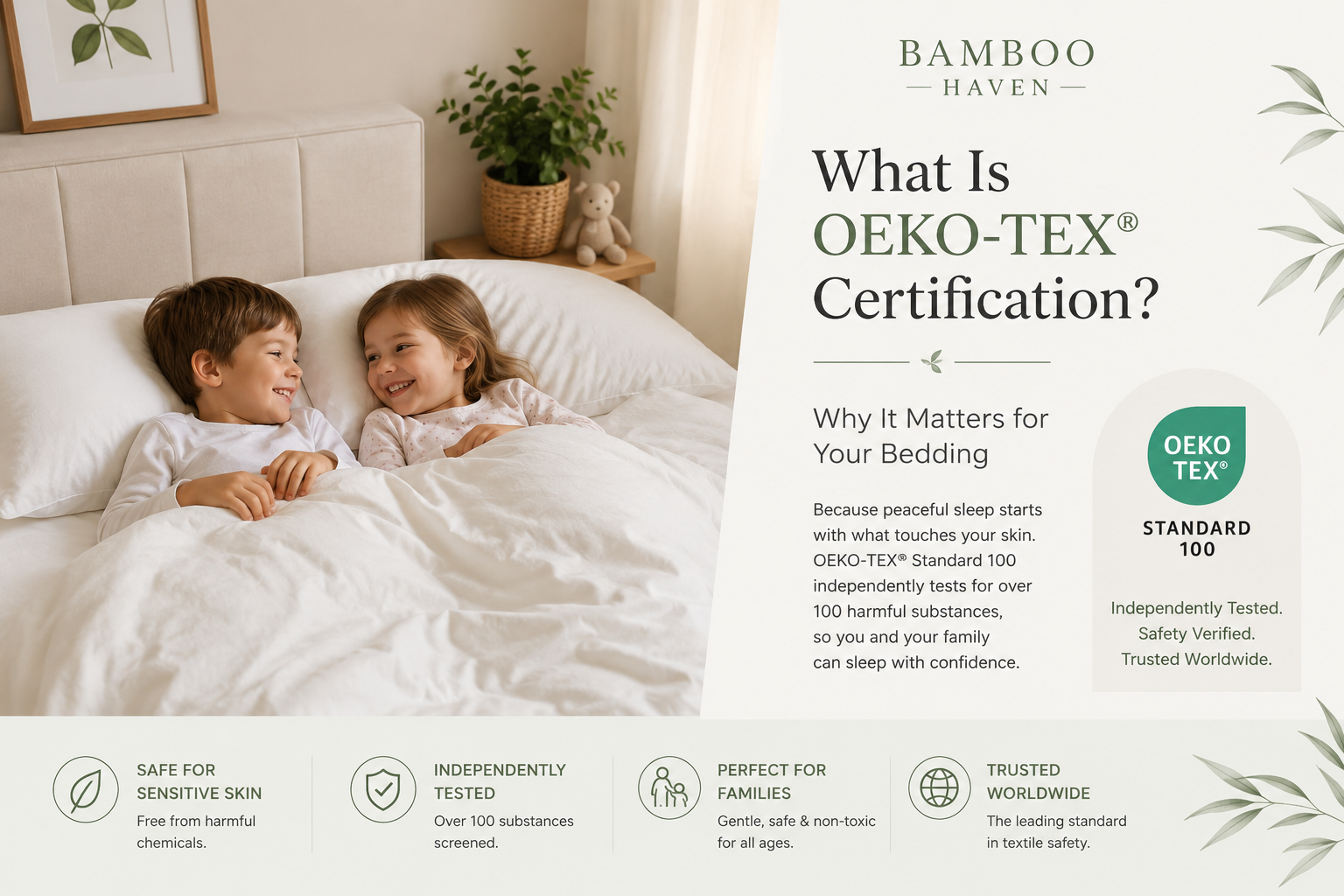
OEKO-TEX is an independent testing and certification system for textiles, founded in 1992 and headquartered in Zurich, Switzerland. It operates through a network of partner institutes across Europe and beyond, and is widely regarded as the most credible and rigorous consumer-facing textile safety standard in the world. OEKO-TEX is not affiliated with any government or industry body — its independence is what makes it credible. It publishes its testing criteria publicly, requires annual certificate renewal, and maintains a searchable database of certified products that consumers can use to verify claims.
There are several OEKO-TEX standards covering different aspects of textile production. The most important one for consumers buying bedding is OEKO-TEX Standard 100.
What Does OEKO-TEX Standard 100 Certify?
OEKO-TEX Standard 100 certifies that every component of a textile product — not just the outer fabric, but every thread, button, zip, lining, label, and print — has been independently tested and verified to be free from harmful substances. The tested parameters cover more than 100 substances and include:
- Formaldehyde and other textile finishing chemicals associated with skin irritation and respiratory sensitisation
- Heavy metals including lead, cadmium, chromium, mercury, and arsenic
- Allergenic and carcinogenic dyes and pigments
- Pesticide residues from agricultural production
- Phthalates commonly found in synthetic materials
- pH levels — fabrics that are too acidic or alkaline can cause skin irritation
- Colour fastness — ensuring dyes do not transfer to skin during use or washing
Testing is conducted entirely by independent OEKO-TEX partner institutes — not by the brand or manufacturer. Certificates must be renewed annually, meaning a product cannot claim OEKO-TEX Standard 100 status based on a one-time test from years ago. This ongoing verification is what makes the certification genuinely meaningful rather than a historic credential that may no longer reflect current production.
Why This Matters for Bedding Specifically
The case for OEKO-TEX certification is particularly strong for bedding, for a simple reason: extended skin contact time. A garment might be worn for a few hours and then removed. Bedding is in direct, uninterrupted contact with your skin — including your face, neck, and hands — for seven to nine hours per night. Over the course of a year, that represents more than 2,500 hours of contact with whatever the fabric contains.
For healthy adults with no particular sensitivities, this prolonged contact with chemical residues in uncertified fabric may have a mild or unnoticed effect. For those with sensitive skin, eczema, allergies, or asthma, the impact can be significant and disruptive to both sleep quality and skin health. For infants and young children, whose skin is more permeable and whose immune systems are still developing, the stakes are higher still — making OEKO-TEX certification especially important when choosing cot bedding or children's bedding.
The Problem with Unverified Claims
The UK bedding market contains many products described as natural, organic, eco, clean, or non-toxic. These terms have no standardised definition in UK textile retail, no independent verification requirement, and no regulatory enforcement. A product can be described as natural while containing synthetic chemical treatments. A product can be marketed as eco without any accountability for its manufacturing process. These terms are, in the absence of independent certification, marketing language rather than verified fact.
OEKO-TEX Standard 100 is categorically different. It is a third-party verified standard with published testing criteria, a publicly searchable certificate database, and annual renewal requirements. When you see a valid OEKO-TEX Standard 100 certificate number on a product, you can verify it within minutes at oeko-tex.com. If a brand claims certification but cannot provide a verifiable certificate number, treat that claim with appropriate scepticism.
How to Verify an OEKO-TEX Certificate
The verification process is simple and takes less than a minute. Any product with genuine OEKO-TEX Standard 100 certification will carry a certificate number. Enter this number at oeko-tex.com to confirm that the certificate is current, that it covers the specific product you are purchasing, and that the certifying institute is an accredited OEKO-TEX partner. Bamboo Haven's OEKO-TEX certification is current, verifiable, and covers every product in the range — including the wooden buttons used on duvet covers, not just the outer fabric.
Other Certifications Worth Knowing
- GOTS (Global Organic Textile Standard): Covers both organic fibre sourcing and responsible processing throughout the supply chain. The most comprehensive certification for organically grown fibres.
- Bluesign: Focused on responsible and resource-efficient manufacturing processes. Strong on environmental performance but less consumer-facing than OEKO-TEX.
- Fair Trade Certified: Covers labour standards and fair payment in production. Addresses social rather than product safety criteria.
- OEKO-TEX MADE IN GREEN: A combined standard that includes OEKO-TEX Standard 100 product testing alongside environmental and social assessments of the production facility.
- Rainforest Alliance: Primarily an agricultural certification covering responsible sourcing of raw materials.
Of these standards, OEKO-TEX Standard 100 is the most directly relevant to consumer safety in the finished product. It answers the most important question a bedding buyer can ask: is it safe to sleep in this fabric every night?
Bamboo Haven and OEKO-TEX Certification
Every product in the Bamboo Haven range — including the full bedding sets, individual duvet covers, fitted sheets, pillowcases, pillows, and comforter — carries OEKO-TEX Standard 100 certification. This covers not only the 100% bamboo viscose fabric but also the wooden buttons used on duvet covers, ensuring that every component you sleep near is independently verified to be free from harmful substances. For Bamboo Haven, certification is not a marketing point — it is a baseline standard applied across every product without exception. The commitment to OEKO-TEX reflects the same values that drive the brand's choice of 100% bamboo viscose, wooden buttons, and natural materials throughout.
How OEKO-TEX Testing Actually Works
Understanding the practical testing process behind OEKO-TEX Standard 100 helps explain why the certification carries genuine weight rather than being a marketing formality. Manufacturers seeking certification submit fabric and finished product samples to an accredited OEKO-TEX partner institute, where laboratory analysis is conducted against the published list of over 100 regulated substances, with limits that vary depending on the product's intended use — stricter limits apply to products intended for babies and young children than to general adult textiles, and stricter limits again apply to products with direct, extended skin contact, a category bedding sits firmly within.
This is not a paperwork exercise completed by the brand itself. The testing institute is independent of the manufacturer, has no commercial relationship that could bias the outcome, and applies the same published testing criteria consistently across every submission it receives. Only once a product passes this independent laboratory analysis is a certificate issued, and that certificate must be renewed on an annual basis — meaning a manufacturer cannot rely on a single historic test to support an indefinite certification claim. Each year's production run must continue to meet the same rigorous standard.
OEKO-TEX Product Classes Explained
OEKO-TEX Standard 100 certification is organised into four product classes, each with progressively stricter substance limits reflecting the level of skin contact and vulnerability of the intended user. Product Class I covers items for babies and toddlers up to three years old, carrying the strictest limits of any category given infants' more permeable skin and developing immune systems. Product Class II covers items with direct and extended skin contact — the category bedding falls into, given the many hours of direct contact involved every single night. Product Class III covers items without direct skin contact, and Product Class IV covers decorative furnishing materials.
Understanding which product class a certification applies to matters because a product certified only to the less strict Product Class III or IV standard provides meaningfully less assurance for bedding than genuine Product Class II certification. When checking a certificate number at oeko-tex.com, confirming that the certification covers the appropriate product class for direct, extended skin contact is a worthwhile extra step for anyone buying bedding specifically for its safety credentials, rather than assuming any OEKO-TEX mention automatically means the strictest possible standard has been applied.
Why Annual Renewal Matters More Than a One-Time Test
It is worth returning to a point made earlier in this guide because it is genuinely central to what makes OEKO-TEX certification meaningful: the requirement for annual renewal. Textile manufacturing supply chains change — a manufacturer might switch dye suppliers, adjust a finishing process, or introduce a new component, any of which could introduce a previously untested substance into the finished product. A certification system based on a single historic test would have no way of catching these changes.
By requiring recertification every year, OEKO-TEX ensures that a currently valid certificate genuinely reflects the product as it is being manufactured today, not as it was manufactured whenever the brand first sought certification. This is a meaningful practical safeguard, and it is why checking that a certificate is current — not simply that a brand has mentioned OEKO-TEX at some point — remains an important part of verifying any bedding safety claim.
Shop OEKO-TEX certified bamboo bedding at https://bamboohaven.co.uk