How to Buy Bamboo Bedding: The Complete UK Buyer's Guide
The market for bamboo bedding in the UK has grown significantly in recent years, and with that growth has come an abundance of confusing terminology, inflated claims, and products that trade on the bamboo label without delivering bamboo's genuine benefits. If you are considering investing in bamboo bedding for the first time, or looking to upgrade from a previous purchase that did not live up to expectations, this guide gives you the knowledge to choose wisely and confidently the first time.
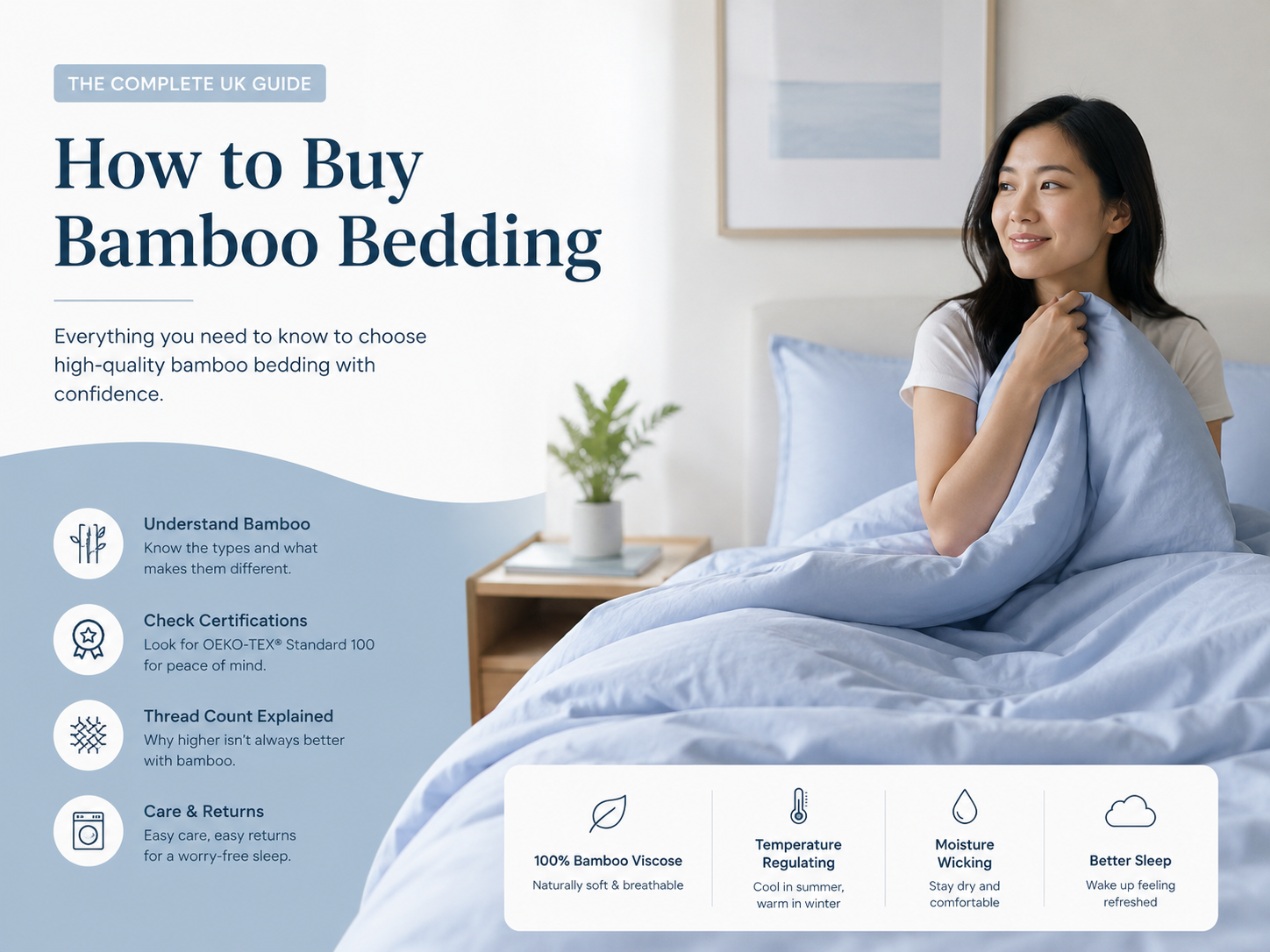
Step One: Understand What Bamboo Bedding Actually Means
The term bamboo bedding covers several very different products. The bamboo label alone tells you little about what you are actually buying. These are the main types you will encounter in UK retail:
- Bamboo viscose (bamboo rayon): The most common and most luxurious type. Made from dissolved bamboo pulp, producing an exceptionally soft, breathable, and moisture-wicking fabric. This is what Bamboo Haven uses throughout its range.
- Bamboo lyocell: A newer, more environmentally closed-loop manufacturing process. Slightly less common and often priced at a premium. Similar feel to bamboo viscose.
- Bamboo linen: Mechanically processed from bamboo stalks. Coarser texture, quite different feel from viscose. Rare in mainstream bedding.
- Bamboo blends: Often marketed simply as bamboo despite containing significant proportions of polyester or other synthetic fibres. Inferior breathability and softness, and less environmentally responsible than pure bamboo fabric.
Always read the full fabric composition on the label or product description before purchasing. A product described as bamboo that contains 30% polyester is meaningfully different from one made from 100% bamboo viscose — in softness, breathability, moisture management, environmental impact, and microplastic output.
Step Two: Check the Fabric Composition
Look specifically for 100% bamboo viscose products. This matters for several reasons. Pure bamboo viscose delivers the full range of bamboo's sleep benefits — breathability, moisture wicking, thermoregulation, and hypoallergenic properties. When polyester or other synthetics are blended in, each of these properties is compromised to a degree proportional to the synthetic content. A 70/30 bamboo-polyester blend is significantly less breathable and moisture-wicking than a pure bamboo product — and it will feel different against the skin.
Polyester blends also introduce plastic microfibres into wash water — a growing environmental concern that 100% natural fibre products avoid. For environmentally conscious buyers, this is an additional reason to insist on 100% bamboo viscose.
Step Three: Look for Independent Certification
OEKO-TEX Standard 100 certification is the most important credential to look for when buying bamboo bedding. This independent certification — issued by accredited testing institutes, not by manufacturers themselves — verifies that every component of the product has been tested and confirmed free from over 100 harmful substances, including formaldehyde, heavy metals, allergenic dyes, and pesticide residues.
Any genuine OEKO-TEX Standard 100 certification comes with a certificate number that you can verify at oeko-tex.com. If a brand claims certification but cannot provide a verifiable certificate number, treat that claim with appropriate caution. All Bamboo Haven products carry current, verifiable OEKO-TEX Standard 100 certification.
Step Four: Understand Thread Count
Thread count — the number of threads per square inch of fabric — is a widely used but frequently misunderstood metric in bedding retail. In cotton bedding, higher thread counts generally (though not always) indicate a finer, softer fabric. In bamboo bedding, thread count is a less meaningful metric because bamboo viscose fibres are inherently much finer than cotton. A 300 thread count bamboo fabric can feel softer and silkier than a 1,500 thread count Egyptian cotton, because each bamboo thread is finer and more flexible.
Bamboo Haven's 300 thread count reflects an honest, optimised specification rather than an inflated marketing figure. Be particularly sceptical of bamboo bedding claiming thread counts above 600. This figure is almost impossible to achieve honestly with bamboo viscose and typically indicates either a blended product, multi-ply yarn counting, or simply a misleading marketing claim.
Step Five: Consider the Full Product Range
The benefits of bamboo bedding — thermoregulation, breathability, moisture wicking — are most fully experienced when the entire sleep surface is bamboo viscose. If budget is a constraint, starting with pillowcases and a fitted sheet gives you the most skin contact with the fabric at the lowest initial cost. Multiple Bamboo Haven customers describe starting with just the pillowcases, immediately noticing the difference, and quickly returning to purchase the full set.
Building a complete bamboo bedding set over time is entirely practical. Bamboo Haven's individual pieces — duvet cover, fitted sheet, pillowcases, comforter, and pillows — are all available separately and designed to work together as a cohesive collection in five complementary colours.
Step Six: Check Care Requirements and Returns Policy
Quality bamboo bedding should be machine washable at home at 30-40 degrees on a gentle cycle. Be cautious about any bamboo bedding that requires dry cleaning or special treatment — this either indicates an unusual fabric construction or an attempt to reduce returns by making care impractical. All Bamboo Haven bedding is easily machine washable and designed to improve with each wash, becoming softer rather than stiffer over time.
Red Flags to Watch For
- No specific fabric type stated beyond bamboo on the product label
- Thread counts above 600 for bamboo products — almost certainly misleading
- No independent certification or an unverifiable certification claim
- Any mention of polyester, microfibre, or synthetic in the fabric composition
- Prices significantly below market rate for bamboo bedding — typically a sign of blended fabrics or misleading claims
- Vague sustainability claims without third-party verification
- No clear care instructions on the product or packaging
Why Bamboo Haven Meets Every Criterion in This Guide
Bamboo Haven's entire range is 100% bamboo viscose, clearly labelled, OEKO-TEX Standard 100 certified, machine washable, and available as individual pieces or complete sets. The 300 thread count reflects an honest, optimised specification rather than an inflated marketing figure. The wooden buttons on duvet covers replace plastic, maintaining a commitment to natural materials throughout. The range is available in five carefully selected tones designed to complement considered, calm bedroom interiors — soft beige, sage green, blush pink, ice blue, and navy.
Sarah K. from Whitby, a verified customer who started with the pillowcases and said there was no going back after the first night, describes the Bamboo Haven experience in a sentence: quality that is obvious from the moment you open the box. That is the standard that this buyer's guide is designed to help you find.
Understanding Bamboo Bedding Pricing
Bamboo bedding pricing in the UK varies considerably, and understanding what drives that variation helps you assess whether a specific price represents genuine value. At the lower end of the market, very cheap bamboo-labelled bedding is almost always either a synthetic blend rather than 100% bamboo viscose, or produced without the responsible, certified manufacturing processes discussed elsewhere in this guide — both of which reduce production cost at the expense of the properties that make bamboo bedding worth choosing in the first place. Genuine 100% bamboo viscose, properly manufactured and independently certified, has real production costs behind it that a rock-bottom price simply cannot cover honestly.
At the premium end, some brands charge a significant markup that reflects packaging, retail markup, or brand positioning rather than any meaningful difference in the underlying fabric quality. The most reliable way to assess value is to compare fabric composition, certification, and thread count specification directly across brands at a similar price point, rather than assuming the most expensive option is automatically the best, or that the cheapest option represents a genuine bargain rather than a compromised product.
Questions to Ask Before You Buy
A short list of direct questions can quickly separate genuinely high-quality bamboo bedding from products trading on the bamboo label without delivering its real benefits. Is the fabric composition stated as 100% bamboo viscose, or does it include a percentage of polyester or other synthetic fibres? Is there a specific, verifiable OEKO-TEX Standard 100 certificate number provided, and does it cover the appropriate product class for direct skin contact? What is the stated thread count, and is it a plausible figure for genuine bamboo viscose construction rather than an inflated marketing claim above 600?
Is the care information clear and does it specify machine washability at home, or does it require impractical dry cleaning that suggests an unusual or lower-quality construction? Finally, does the brand provide transparent information about its manufacturing process and certification on request, or does it rely on vague terms like natural and eco without supporting evidence? A brand confident in its product quality should be able to answer every one of these questions clearly and specifically — Bamboo Haven publishes clear answers to each of them across its product pages and this buyer's guide.
Buying for Different Household Needs
Different households have different priorities when buying bamboo bedding, and it is worth matching your purchase to your specific situation rather than assuming a single approach suits everyone. Buyers prioritising allergy relief or sensitive skin should pay particular attention to certification and 100% bamboo composition above all else. Buyers primarily motivated by temperature regulation and hot sleeping should prioritise fitted sheets and pillowcases first, since these carry the most direct, sustained body contact. Buyers furnishing a guest room or planning ahead for gifting should consider the full range of available colours and sizes to ensure a cohesive, versatile set that will suit a range of tastes and bed sizes over time.
Shop the full Bamboo Haven range at https://bamboohaven.co.uk