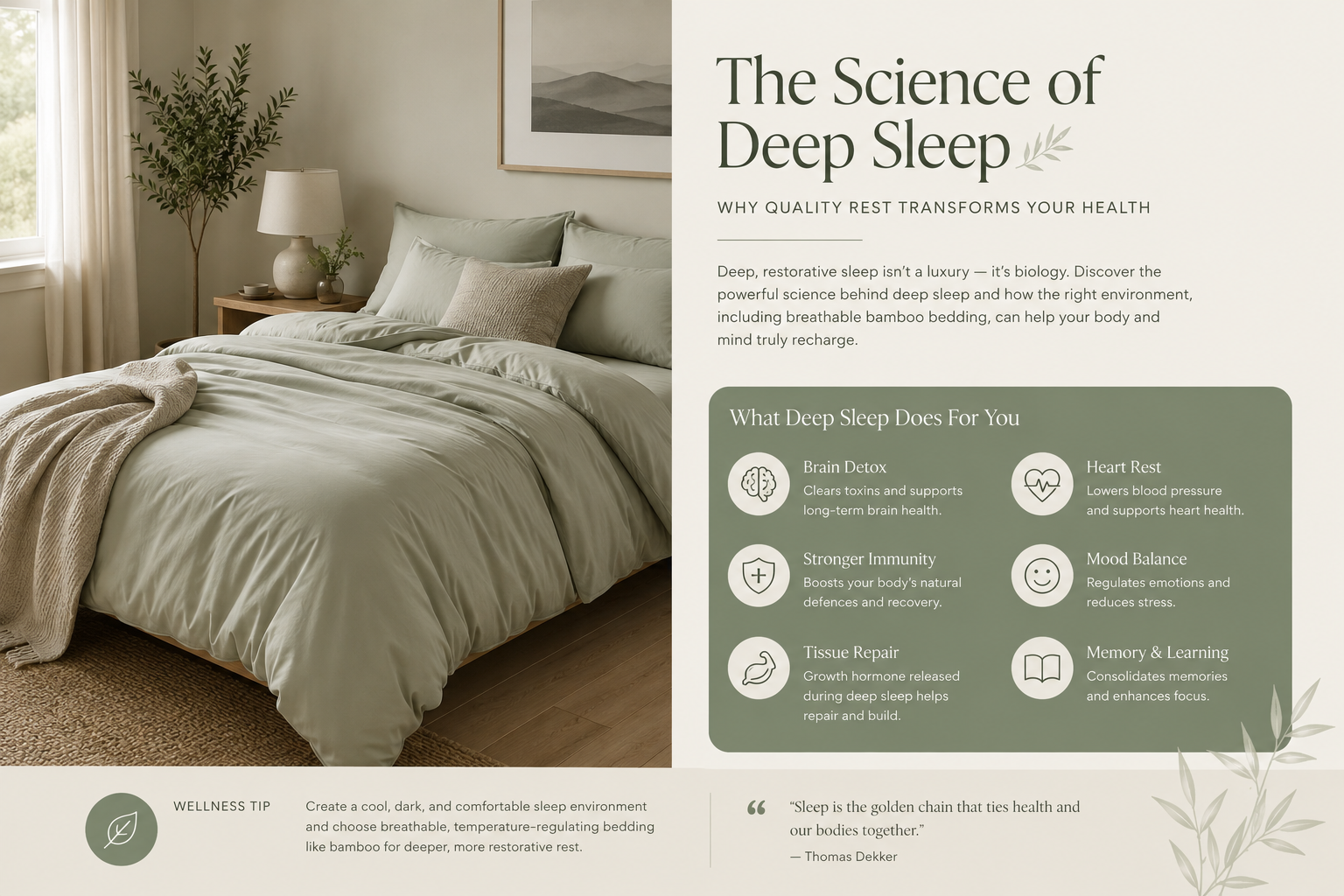
The Science of Deep Sleep: Why Quality Rest Transforms Your Health
We spend approximately one third of our lives asleep. Yet despite the enormous proportion of our time devoted to it, most of us understand very little about what actually happens during those hours — or why the quality of sleep, not just its duration, has such a profound effect on almost every aspect of how we feel, think, and function. The science of sleep has advanced significantly in recent decades. What it reveals is both clarifying and, for many people, genuinely motivating: deep, restorative sleep is not a luxury or a passive state. It is one of the most biologically active and consequential things your body does every night.
The Architecture of a Night's Sleep
Sleep is not a uniform state of unconsciousness. It progresses through a series of distinct stages that cycle repeatedly throughout the night, each lasting approximately 90 minutes in a healthy adult. A typical night contains four to six of these cycles. The composition of each cycle changes as the night progresses — early cycles contain more deep sleep; later cycles contain more REM sleep. Disrupting this architecture — even without fully waking — has measurable consequences for how rested you feel and how well your body has recovered.
Stage 1: The Transition
Stage 1 is the lightest phase of sleep — the transition from wakefulness to sleep that most people experience as a gradual drifting sensation. Brain activity shifts from the fast, alert beta waves of wakefulness to slower alpha and then theta waves. Muscle activity decreases, eye movements slow, and core body temperature begins to drop. This stage is easily disrupted by noise, light, or discomfort, and it typically lasts just a few minutes in each cycle.
Stage 2: Established Light Sleep
Stage 2 involves more consistent disengagement from the external environment. Heart rate slows further, body temperature continues to drop, and eye movements cease. Sleep spindles — brief, rhythmic bursts of neural activity — are characteristic of this stage and are associated with memory consolidation and learning. Stage 2 accounts for approximately 45-55% of total sleep time in adults and serves important cognitive functions despite being classified as light sleep.
Stage 3: Deep Sleep (Slow-Wave Sleep)
Stage 3 is the most physically restorative phase of the sleep cycle and the one most directly affected by sleeping environment and bedding quality. During slow-wave sleep, brain activity shifts to long, slow delta waves. The body enters a state of deep physical rest: heart rate and breathing reach their lowest levels, muscles relax fully, and growth hormone is released in its largest single pulse of the day. This hormone drives tissue repair, muscle recovery, and immune function at a cellular level.
The brain's glymphatic system — a network that clears metabolic waste from neural tissue — is most active during deep sleep. This system removes by-products of neural activity including amyloid beta and tau proteins, which are associated with Alzheimer's disease and other neurodegenerative conditions when allowed to accumulate over time. Deep sleep is therefore not simply physically restorative — it is actively protective of long-term brain health in ways that are increasingly well-understood.
REM Sleep: The Restorative Phase for the Mind
Rapid Eye Movement sleep is when the majority of vivid dreaming occurs. During REM, the brain is highly active — almost as active as during wakefulness — while the body's major muscles are temporarily paralysed, preventing physical acting-out of dreams. REM sleep is critical for emotional processing, memory consolidation and integration, creativity, and the regulation of mood. The proportion of REM sleep increases in later cycles of the night, which is why the last one to two hours of sleep contain a disproportionately large amount of REM — and why cutting sleep short is particularly damaging to emotional wellbeing and memory formation.
What Happens During Deep Sleep: The Biological Detail
- Growth hormone release: The anterior pituitary gland releases growth hormone in its primary daily pulse during slow-wave sleep, driving tissue and muscle repair, immune cell production, and metabolic regulation
- Glymphatic waste clearance: Cerebrospinal fluid flows through the brain's interstitial spaces during deep sleep, flushing out metabolic by-products associated with neurodegenerative disease
- Memory consolidation: Information processed during waking hours is transferred from the hippocampus to the cortex for long-term storage during deep sleep
- Immune system support: Deep sleep promotes the production of cytokines — proteins that regulate immune response and inflammation — making deep sleep critical for recovery from illness and infection
- Cardiovascular recovery: Heart rate and blood pressure reach their lowest daily levels, providing essential rest for the cardiovascular system
- Hormone regulation: Cortisol reaches its lowest point during deep sleep, and appetite-regulating hormones leptin and ghrelin are balanced during adequate deep sleep cycles
The Consequences of Insufficient Deep Sleep
Chronic deprivation of deep sleep — even in the absence of total sleep loss — has wide-ranging consequences that accumulate over time. These include increased risk of cognitive decline and dementia due to impaired glymphatic clearance, impaired immune function due to reduced cytokine production, elevated inflammatory markers throughout the body, weight gain through disruption of ghrelin and leptin balance, deteriorating mood and emotional regulation, and reduced physical performance and recovery capacity.
The consequences of poor sleep quality are not confined to feeling tired the next day. They compound over weeks, months, and years into measurable health outcomes. This is why investing in the conditions that support deep sleep — including the environment you sleep in and the bedding you sleep under — is one of the most consequential health decisions most adults can make.
What Disrupts Deep Sleep?
- Elevated body temperature: The single most direct environmental obstacle to deep sleep. Core body temperature must drop by approximately one degree Celsius and remain lower throughout the night to sustain slow-wave sleep.
- Noise: Sudden sounds cause arousal from deep sleep even without conscious waking, fragmenting sleep cycles invisibly and affecting restoration
- Light: Suppresses melatonin and increases arousal, making both sleep onset and maintenance of deep sleep harder to achieve
- Alcohol: Widely misunderstood as a sleep aid; significantly suppresses slow-wave deep sleep and fragments sleep architecture in the second half of the night
- Stress and anxiety: Elevated cortisol from psychological stress directly antagonises the conditions required for deep sleep entry and maintenance
- Poor bedding: Heat-trapping or uncomfortable bedding raises ambient temperature around the body, inhibiting the core temperature drop necessary for deep sleep
How Bedding Affects Deep Sleep Quality
Body temperature regulation is the environmental variable most directly under your control during sleep — and bedding is its primary determinant. The body needs to maintain a cooler core temperature throughout the night to sustain deep sleep. Bedding that traps heat works directly against this process, raising the temperature around the body, increasing physiological arousal, and preventing the sustained deep sleep cycles where recovery happens.
Bamboo Haven's 100% bamboo viscose bedding is engineered specifically to support thermoregulation during sleep. The naturally breathable fibre structure promotes continuous airflow, wicking moisture away from the skin and allowing heat to escape rather than accumulate. The result is a stable, cooler sleep microclimate that remains consistent through the night rather than gradually warming as the night progresses.
The difference is felt in two ways. In the short term, the cooler sleep environment supports faster sleep onset and deeper initial sleep cycles — most customers notice the difference within the first few nights. Over time, consistently better deep sleep delivers the full range of restorative benefits: improved physical recovery, better immune function, sharper cognition, more stable mood, and the kind of genuine restfulness that makes a measurable difference to daily life.
Optimising Your Environment for Deep Sleep: A Summary
- Maintain bedroom temperature at 16-18 degrees Celsius
- Use breathable, temperature-regulating bamboo viscose bedding
- Eliminate light with blackout curtains and covered standby LEDs
- Manage sound with white noise, earplugs, or heavy curtains
- Avoid alcohol within three hours of sleep
- Establish a consistent sleep schedule including weekends
- Reduce psychological stress through pre-sleep relaxation practice
- Avoid caffeine after midday and heavy meals within two hours of sleep
Combining all of these factors — and starting with the bedding, which affects every minute of every night — gives your body the best possible conditions for the deep, restorative sleep that supports everything else in your life.
How Much Deep Sleep Do You Actually Need?
Deep sleep typically accounts for somewhere between 13 and 23% of total sleep time in a healthy adult, translating to roughly one to two hours across a full night for someone sleeping seven to eight hours in total. This proportion naturally declines with age — a well-documented pattern that begins in the thirties and continues gradually throughout adulthood, which is part of why older adults often report lighter, more easily disrupted sleep compared with their younger years, even without any specific sleep disorder present.
Rather than fixating on an exact number of minutes or hours of deep sleep, which varies naturally between individuals and across different nights for the same person, the more useful practical measure is how rested and functional you feel during the day. Consistently waking unrefreshed despite adequate total sleep time, or relying heavily on caffeine to function through the day, are more meaningful practical signals that deep sleep may be insufficient than any specific number derived from a sleep tracking device, many of which vary considerably in accuracy when it comes to precisely distinguishing sleep stages.
Invest in deeper, more restorative sleep with Bamboo Haven at https://bamboohaven.co.uk