Is Bamboo Bedding Really Sustainable? An Honest, Evidence-Based Guide
Sustainability has become one of the most prominent — and most contested — marketing claims in the UK bedding market. Bamboo is frequently positioned as an inherently eco-friendly material, and there are real reasons to regard it as a more sustainable choice than cotton. But there are also aspects of bamboo fabric production that deserve honest examination rather than glossy marketing treatment. This guide gives you the full picture: where the evidence for bamboo's sustainability is strong, where it is more nuanced, and how to identify brands that back their environmental claims with verifiable credentials.
The Genuine Sustainability Strengths of Bamboo
Exceptional Growth Rate and Renewability
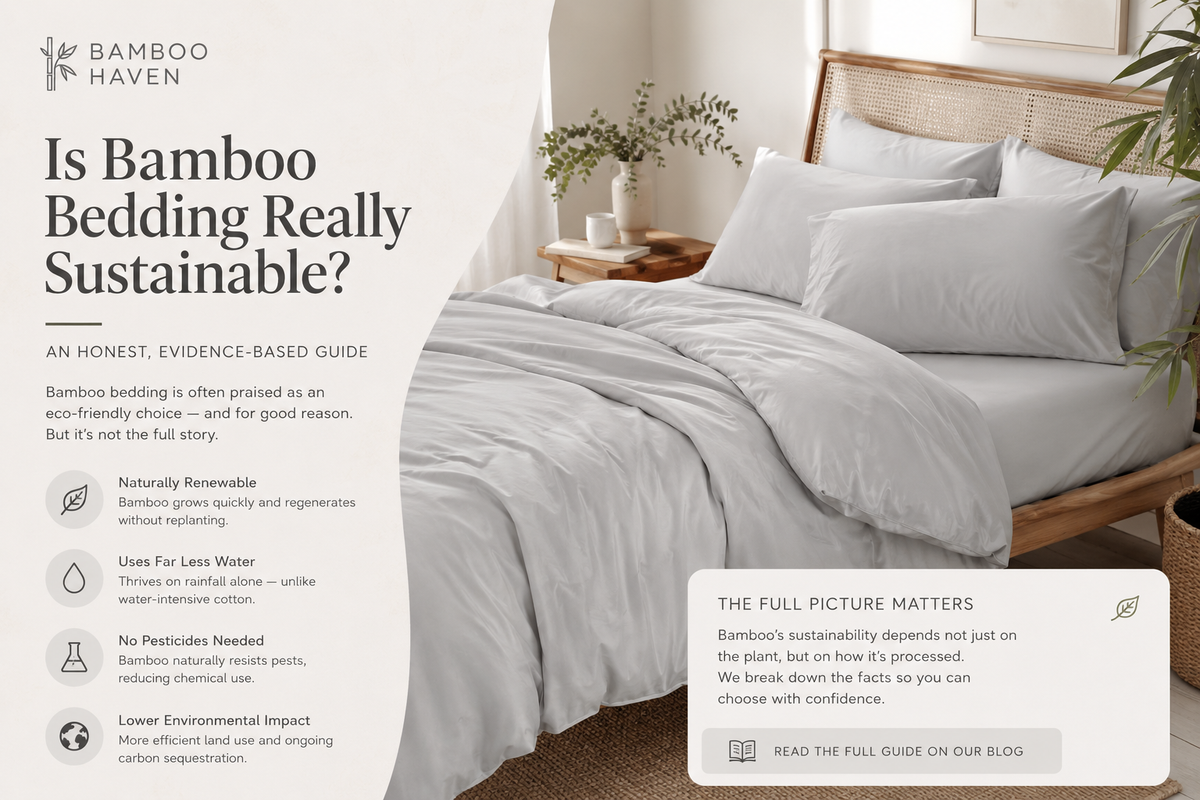
Bamboo is among the fastest-growing plants on the planet. Moso bamboo — the species most commonly used for textile production — can grow up to 90 centimetres per day under optimal conditions and reaches harvestable maturity in three to five years. By comparison, hardwood trees used in conventional viscose production take decades to reach maturity. After harvesting, bamboo regenerates from its existing root system without replanting, making it a continuously renewable raw material when managed responsibly. This regeneration also means that the soil is not disturbed during harvest, reducing erosion and maintaining the ecosystem of the growing area.
Minimal Water Requirements
Bamboo typically grows on rainfall alone, without irrigation. This stands in stark contrast to cotton, which is one of the most water-intensive crops in global agriculture. The production of one kilogram of conventional cotton requires approximately 10,000 litres of water — a figure that includes irrigation, processing, and dyeing. Growing regions for cotton in Uzbekistan, India, and the United States have experienced significant water depletion as a direct result of cotton agriculture. Bamboo avoids this water burden at the raw material stage almost entirely.
No Pesticides or Artificial Fertilisers
Bamboo naturally resists pests due to its rapid growth rate and the presence of natural antimicrobial compounds in the plant. Commercial bamboo cultivation does not require pesticide application in most cases, and the plant draws nutrients effectively from soil without the need for artificial fertilisers. Cotton farming, by contrast, uses approximately 16% of the world's insecticides and around 7% of pesticides — a disproportionate environmental burden for a crop representing less than 3% of global farmland.
Carbon Sequestration
Bamboo sequesters carbon throughout its continuous growth cycle. Because the plant is not killed during harvesting and regenerates rapidly, the carbon sequestration process continues without interruption. Some estimates suggest bamboo sequesters more carbon per hectare than equivalent areas of forest — though specific figures vary depending on species, climate, and management practices. What is clear is that well-managed bamboo plantations provide an ongoing carbon sink rather than a one-time sequestration event.
Land Efficiency
Bamboo's rapid growth rate and high yield per hectare mean that significantly more usable fibre can be produced per unit of land compared to cotton. In regions where land is a constrained resource, this efficiency matters — and it means that bamboo production exerts less pressure on land use and biodiversity than cotton farming at comparable output volumes.
Where the Picture Is More Complex: The Viscose Manufacturing Process
The primary environmental nuance with bamboo bedding relates not to the plant itself but to the process by which it is converted into fabric. Turning bamboo pulp into viscose involves dissolving cellulose in chemical solvents, most commonly sodium hydroxide and carbon disulfide. These chemicals are effective at producing fine, soft fibres, but they can have environmental consequences if not managed responsibly.
In facilities that do not use closed-loop chemical systems, spent solvents may be discharged into waterways or the atmosphere, representing a genuine environmental harm. In responsible, certified facilities that employ closed-loop systems, the chemicals are captured and recycled with minimal environmental release. The difference in environmental impact between these two production approaches is substantial — and it is the reason why transparency and third-party certification matter so much when evaluating bamboo bedding brands.
It is worth noting that this manufacturing concern is not unique to bamboo — conventional cotton processing also involves significant chemical use in dyeing, bleaching, and finishing, with variable environmental management depending on the facility. The question is not whether chemical processing occurs, but whether it is managed responsibly.
How to Identify Genuinely Responsible Bamboo Bedding
The most reliable consumer-facing indicator of responsible bamboo bedding production is independent third-party certification. OEKO-TEX Standard 100 certification — carried by every Bamboo Haven product — verifies that the finished fabric is free from harmful chemical residues regardless of what happened during production. While this certification addresses product safety rather than the full environmental impact of the manufacturing process, it is the most practical and verifiable assurance available to consumers.
Brands that provide transparent information about their supply chain, manufacturing location, and certification credentials are more credible than those that rely solely on general terms such as eco, natural, or green without supporting evidence. When a brand can provide a verifiable OEKO-TEX certificate number, that is a meaningful signal of genuine commitment to product quality and safety.
Bamboo vs Cotton: A Comprehensive Sustainability Comparison
- Water consumption: Bamboo requires minimal water; cotton is highly water-intensive at approximately 10,000 litres per kilogram
- Pesticide use: Bamboo requires none; cotton accounts for a disproportionate share of global pesticide use
- Land efficiency: Bamboo produces more fibre per hectare due to rapid growth and continuous regeneration
- Carbon sequestration: Bamboo sequesters carbon continuously; cotton does not
- Manufacturing process: Both involve chemical processing; closed-loop bamboo production is significantly more responsible
- Durability: Long-lasting bamboo bedding means less frequent replacement and lower lifetime resource consumption
- Microplastics: 100% bamboo viscose produces no plastic microfibres in washing; blended or synthetic bedding does
The Durability Factor: Sustainability Over a Lifetime
Sustainability is not only about production — it is also about longevity. Bedding that lasts for years, maintaining its quality and performance, represents a fundamentally lower environmental impact than bedding that must be replaced frequently. Bamboo Haven's 100% bamboo viscose bedding is designed to last: getting softer with each wash rather than degrading, maintaining its structure through years of regular use, and delivering consistent performance that reduces the frequency of replacement. This durability is itself an environmental credential.
The Honest Bottom Line
Bamboo bedding is genuinely more sustainable than conventional cotton across most meaningful measures at the raw material level. The manufacturing process introduces environmental considerations that should be acknowledged honestly rather than glossed over — but OEKO-TEX certified products from responsible brands represent one of the most consciously produced bedding options available to UK consumers. Bamboo Haven's commitment to 100% bamboo viscose, OEKO-TEX certification, natural wooden buttons, and durable construction reflects a brand that takes sustainability seriously beyond the surface level of green marketing.
Comparing Bamboo Viscose to Polyester and Synthetic Bedding
While much of the sustainability conversation around bedding focuses on bamboo versus cotton, it is worth directly addressing how bamboo viscose compares to polyester and other synthetic bedding fabrics, which remain widely available at the budget end of the UK market. Polyester is derived from petroleum, a non-renewable fossil resource, and its production is considerably more energy-intensive than bamboo cultivation and processing combined. Polyester bedding also sheds plastic microfibres into wash water with every laundry cycle — a well-documented and growing source of microplastic pollution in waterways that 100% natural fibre products such as bamboo viscose do not contribute to.
Polyester bedding also tends to have a considerably shorter practical lifespan than well-made bamboo viscose, since it does not improve with washing in the way bamboo viscose does, and more frequent replacement compounds its environmental impact over time through repeated manufacturing, packaging, and disposal cycles. When the full picture is considered — raw material sourcing, manufacturing energy demand, microplastic shedding, and product lifespan — bamboo viscose offers a substantially stronger environmental profile than synthetic bedding alternatives, even before accounting for its comfort and performance advantages.
What Happens to Bamboo Bedding at End of Life?
End-of-life disposal is an often-overlooked part of the sustainability picture, and it is an area where 100% bamboo viscose has a genuine advantage over synthetic and blended alternatives. As a regenerated cellulose fibre without synthetic blending, pure bamboo viscose is generally more biodegradable than polyester or polyester-blended fabrics, which can persist in landfill for decades or longer. This does not mean bamboo bedding should simply be discarded casually — textile recycling and reuse remain preferable to landfill for any material — but it does mean that if bedding does eventually reach the end of its usable life, 100% bamboo viscose breaks down more readily than synthetic alternatives.
In practice, well-made bamboo viscose bedding cared for according to the guidance in this article should remain in good, usable condition for years, meaning end-of-life disposal is a consideration that arrives considerably later than it would for lower-quality or synthetic bedding replaced every year or two. Extending a product's usable lifespan through correct care, as discussed elsewhere on this site, remains one of the most effective sustainability actions available to any individual shopper — regardless of which fabric they ultimately choose.
Making Sense of Sustainability Claims When You Shop
Given how much variation exists between bamboo products depending on manufacturing practice, the most useful skill any sustainability-conscious shopper can develop is knowing which claims are independently verifiable and which are simply asserted. A brand stating its product is eco-friendly without any supporting certification is making an unverifiable claim. A brand providing a specific, checkable OEKO-TEX certificate number, transparent information about its manufacturing partners, and honest acknowledgement of the nuances discussed throughout this guide is offering something considerably more substantial to evaluate.
Shop responsibly made, certified bamboo bedding at https://bamboohaven.co.uk