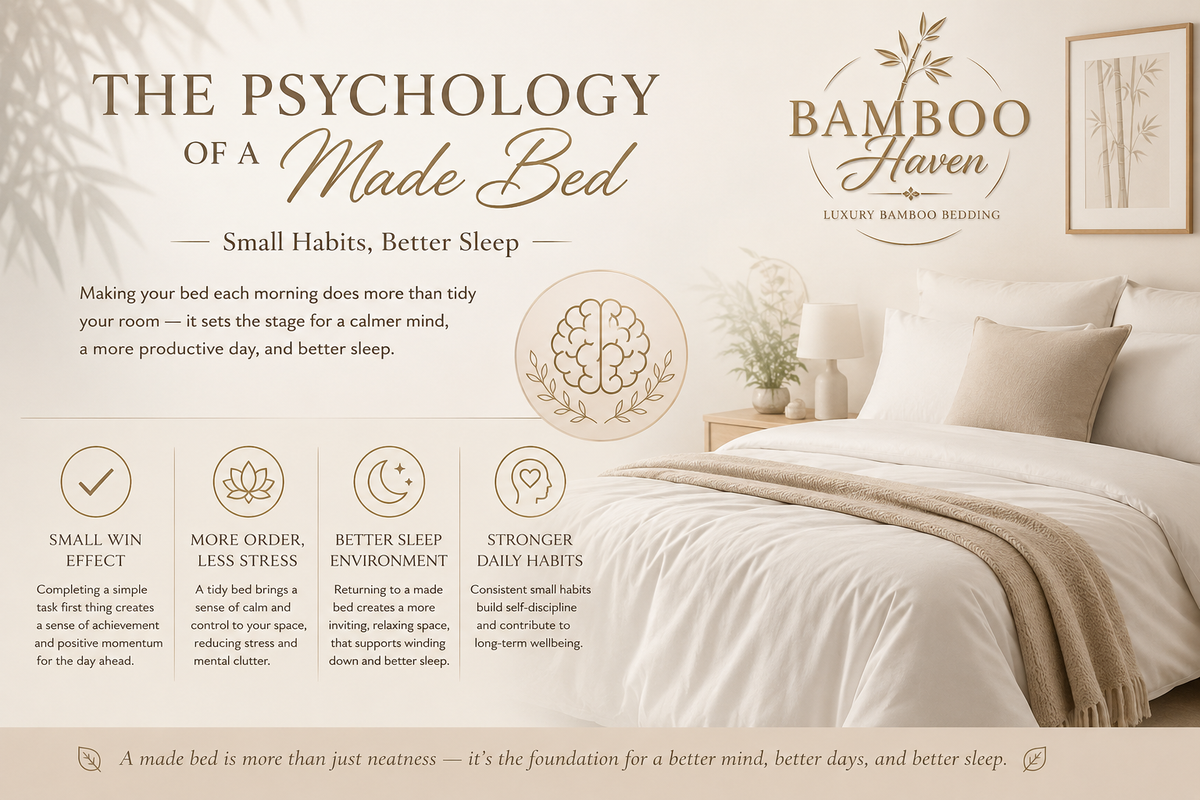
The Psychology of a Made Bed: Small Habits, Better Sleep
Making your bed each morning is one of the smallest, quickest habits in any daily routine, taking a matter of minutes, and yet it carries a surprisingly well-documented connection to wellbeing, productivity and, perhaps counterintuitively, sleep quality itself. Understanding the genuine psychology behind this simple habit helps explain why it consistently appears in advice from productivity experts, sleep specialists and psychologists alike.
The “Small Win” Effect
Behavioural psychology research has increasingly explored the concept of small, achievable “wins” early in the day contributing meaningfully to overall motivation and sense of accomplishment across the rest of that day. Making your bed is one of the simplest possible small wins available — a genuinely completed task, accomplished within minutes of waking, before almost anything else has had the chance to go wrong or feel unfinished. This small sense of accomplishment has been suggested by various behavioural psychologists, including in popular commencement address discussions of the concept, to create a modest but genuine positive momentum that can carry through into how the rest of the day is approached.
This is not to overstate the effect — making your bed will not single-handedly transform a difficult day — but the small, consistent psychological reinforcement of starting the day with one genuinely completed task is a well-supported and genuinely low-cost habit worth considering.
Association Between Bedroom Order and Perceived Control
A body of environmental psychology research has found a meaningful association between a sense of order and control in one’s immediate physical environment and broader feelings of psychological control and reduced stress. A made bed, as the visual and physical centrepiece of most bedrooms, disproportionately affects the overall sense of order or disorder a bedroom conveys, compared with its actual footprint within the room. This means the small act of making the bed can have an outsized effect on how calm, organised and under control the entire bedroom — and by extension, the day ahead — feels, even when nothing else about the room’s tidiness has changed.
The Connection to Sleep Quality Itself
Beyond the general psychological and productivity benefits, there is a more direct connection between bed-making and the sleep environment itself worth understanding. Returning to a made bed at the end of the day creates a more immediately inviting, calm visual environment to wind down in, compared with returning to a bed left in the tangled, disordered state it was left in that morning. Given how strongly visual environment influences perceived calm, as discussed in our dedicated bedroom colour psychology guide, a made bed contributes to this same overall sense of a bedroom that feels genuinely restful and ready for sleep, rather than one that carries a subtle, lingering sense of disorder from earlier in the day.
Some sleep researchers have also suggested that the ritual of making the bed each morning, and the corresponding ritual of unmaking it each evening as part of getting into bed, reinforces the psychological association between the bed and sleep specifically, supporting what sleep specialists refer to as good “sleep hygiene” — the set of habits and environmental cues that help train the brain to associate bed with sleep rather than with other daytime activities.
Also Read : Bamboo Bedding vs Cotton: Which Is Better for Sleep in the UK?
Why an Inviting Bed Genuinely Matters for Winding Down
There is a genuine, practical dimension to this beyond pure psychology: a neatly made bed, with smooth, well-cared-for bedding as discussed throughout our other guides, is simply more physically inviting to get into at the end of the day than a tangled, disordered one. This may seem a small, almost trivial point, but the ease and appeal of the transition into bed plays a genuine role in how readily and comfortably that transition into winding down for sleep actually happens each evening, particularly on nights where motivation or energy for a bedtime routine is already lower than usual.
Making the Habit Sustainable
For anyone wanting to build bed-making into a genuinely consistent daily habit rather than an inconsistent, easily abandoned intention, a few practical approaches help. Keeping the habit genuinely quick and simple — a basic straightening of the duvet and arrangement of pillows takes under a minute and delivers most of the psychological and visual benefit discussed above, without needing to aim for an elaborately styled, hotel-perfect bed each morning. Attaching the habit to an existing, already-established morning routine step, such as making the bed immediately after getting up and before leaving the bedroom, helps the new habit anchor to something already consistently happening rather than needing to be remembered as a separate, standalone task.
Choosing bedding that is genuinely quick and easy to make neatly also removes a practical barrier to consistency: bedding prone to excessive creasing or that requires significant smoothing and adjustment to look presentable adds friction to the habit, while bedding that naturally drapes and sits well, such as well-cared-for bamboo viscose as discussed in our dedicated care guide, makes the daily habit genuinely quicker and more satisfying to complete.
When Bed-Making Isn’t the Priority
It is worth acknowledging, with genuine balance, that there are periods and circumstances where bed-making reasonably falls down the list of priorities — illness, significant stress, new parenthood, or periods of genuine mental health difficulty, for instance. The psychological benefits discussed in this guide are offered as a generally supportive, low-cost habit worth considering when circumstances reasonably allow, rather than as a moral obligation or a marker of personal worth; missing the habit on any given day, or for an extended period during a genuinely difficult time, is entirely normal and not something to feel any particular guilt about.
Cultural and Historical Context
The practice of making one’s bed carries a genuinely long cultural history across many societies, often taught as a basic marker of household order and personal discipline from childhood onward, well before modern behavioural psychology research began formally studying its effects. This long-standing cultural emphasis is worth noting because it suggests the intuitive, widely shared sense that bed-making “matters” in some meaningful way predates, and broadly aligns with, the more recent psychological research discussed throughout this guide, adding a further layer of accumulated, cross-cultural human experience to the more formal behavioural science findings.
How a Made Bed Affects First Impressions of a Bedroom
Beyond its effect on the person who sleeps there, a made bed also shapes how a bedroom is perceived by anyone else who enters it, whether a partner, a family member, or a guest, as discussed in our dedicated guide to creating a genuinely excellent guest room experience. A consistently made bed contributes to an overall sense that a home and its occupants are generally organised and cared for, which can carry subtle but genuine social and relational benefits beyond the purely personal psychological effects discussed earlier in this guide, particularly in shared or frequently visited living spaces.
A Small Habit Worth Keeping
Few habits offer such a favourable ratio of minimal effort to genuine psychological benefit as making your bed each morning. Whether or not you find every specific research finding discussed in this guide personally compelling, the underlying logic — a quick, guaranteed daily accomplishment, a calmer bedroom environment, and a more inviting space to return to each evening — makes a genuinely strong case for keeping this simple habit as part of your own daily routine.
A Habit That Costs Nothing to Try
Unlike many wellbeing recommendations that require financial investment or significant lifestyle change, making your bed each morning costs absolutely nothing beyond a minute or two of your time. This makes it a genuinely risk-free habit to trial for a few weeks, allowing you to judge for yourself whether the effects discussed throughout this guide are noticeable in your own daily experience.
One Small Step Toward a Better Day
If you take away just one habit from this guide, let it be this simple one — the return on investment, in both mood and bedroom atmosphere, is genuinely disproportionate to the minimal effort involved.
Frequently Asked Questions
Q1: Does making your bed actually improve sleep quality, or is this just anecdotal?
Ans: While bed-making itself has not been the subject of extensive dedicated clinical sleep research, it connects to well-established principles around sleep hygiene, visual environment and psychological association between bed and sleep that are genuinely supported by broader sleep science, making it a reasonable, low-cost habit to incorporate rather than a definitively proven standalone intervention.
Q2: How long does making a bed properly actually take?
Ans: A basic, genuinely effective bed-making routine — straightening the duvet and arranging pillows — typically takes well under a minute, meaning the habit’s low time cost is a significant part of why it is such an accessible daily practice for most people.
Q3: Is it worth making the bed if I’m just going to get back into it later that day?
Ans: Yes — the psychological and environmental benefits discussed throughout this guide apply regardless of whether the bed will be used again later in the day for a nap or rest, since the benefit comes substantially from the daily ritual and the visual and psychological effect on the room itself, not solely from how long the bed remains undisturbed.
The simple daily act of making your bed carries a genuinely disproportionate psychological benefit relative to the minimal time it takes, contributing to a sense of accomplishment, a calmer bedroom environment, and a more inviting transition into sleep each evening — making it one of the lowest-cost, most accessible habits worth building into any daily routine.