The Complete UK Bedding Size Guide: Single to Super King
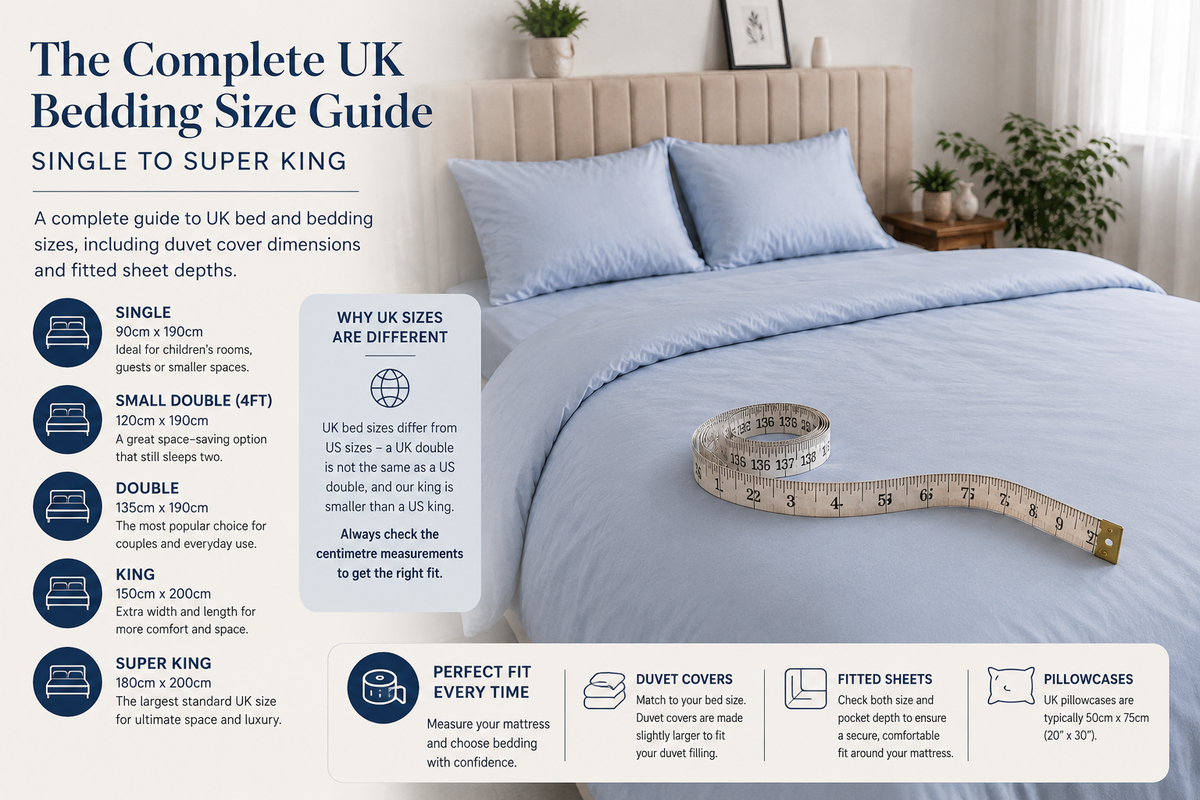
Few shopping mistakes are more frustrating than ordering bedding that turns out to be the wrong size for your bed, and UK bedding sizing has its own specific conventions that can genuinely confuse anyone used to different international standards. This guide sets out exactly how UK bed and bedding sizes work, helping you order with confidence the first time.
Why UK Bed Sizes Differ From Other Countries
UK bed sizing follows its own established naming conventions and dimensions, which differ meaningfully from US sizing in particular, despite sharing some similar naming terms. A UK “double” bed, for instance, is not the same size as a US “double,” and a UK “king” is smaller than a US “king.” This is one of the most common sources of confusion for online shoppers, particularly when browsing bedding on international marketplaces or comparing reviews from customers outside the UK, whose frame of reference may not translate directly to UK measurements. Always checking the specific centimetre measurements listed for UK bedding, rather than relying on the size name alone, is the safest way to avoid ordering the wrong size.
UK Bed Size Overview
Single: The standard UK single bed measures approximately 90cm wide by 190cm long, making it the standard choice for children’s rooms, single-occupancy guest rooms, and smaller box rooms where space is at a premium.
Small Double (also called a “Four Foot”): At approximately 120cm wide by 190cm long, this size sits between a Single and full Double, offering a helpful compromise for smaller rooms that still need to comfortably sleep two people, or for a single sleeper who wants extra space to spread out.
Double: The most common UK bed size for couples and general bedroom use, measuring approximately 135cm wide by 190cm long.
King: A step up from Double, UK King size measures approximately 150cm wide by 200cm long, offering meaningfully more width and additional length compared with a Double, making it a popular choice for couples wanting more personal space, or for taller sleepers who benefit from the additional length.
Super King: The largest widely available UK bed size, Super King measures approximately 180cm wide by 200cm long, offering the most generous sleeping space of the standard UK sizes, and increasingly popular in larger primary bedrooms.
Also Read: The Best Bedding for Sensitive Skin and Eczema: Why Bamboo Wins
Matching Duvet Cover Sizes to Bed Sizes
Duvet covers are sized to correspond with these standard bed dimensions, though it is worth noting that duvet covers are generally cut with some additional allowance beyond the exact mattress dimensions to accommodate the loft and fill of the duvet itself comfortably. When shopping for a duvet cover, always match it to your specific bed size category (Single, Double, King, Super King) rather than attempting to calculate an exact match from your mattress dimensions alone, since duvet cover sizing already accounts for this necessary additional allowance.
It is also worth checking the specific duvet cover dimensions listed on any product you are considering, since there can be modest variation between different brands and manufacturers even within the same nominal size category, and confirming the exact centimetre measurements against your current duvet or bed frame helps avoid any ambiguity before ordering.
Matching Fitted Sheet Sizes and Pocket Depth
Fitted sheets need to match not only your bed’s width and length but also its mattress depth, commonly referred to as pocket depth. Standard UK mattresses have traditionally sat in a moderate depth range, but the growing popularity of deeper, more substantial mattresses — often incorporating memory foam, pocket springs or additional comfort layers — means many modern mattresses require a deeper-pocketed fitted sheet than older standard sheets were designed to accommodate. A fitted sheet with insufficient pocket depth will either fail to stay properly secured around the mattress corners, or will stretch the fabric taut in a way that is both uncomfortable and reduces the sheet’s longevity over time.
Before ordering fitted sheets, measuring your own mattress depth from the top surface to the base is a worthwhile few minutes’ effort, allowing you to confirm the fitted sheet’s stated pocket depth comfortably accommodates your specific mattress rather than assuming a standard depth will automatically fit.
Flat Sheets and Pillowcase Sizing
Flat sheets are generally sized to correspond with the same bed size categories, cut generously enough to tuck comfortably around the mattress with enough overhang for the sheet to remain securely in place through a night of normal movement. Pillowcases are typically sold to fit standard UK pillow dimensions, and are usually sold in pairs for Double, King and Super King bedding sets, reflecting the common convention of two pillows per sleeper in most UK bedrooms.
Common Sizing Mistakes to Avoid
A frequent mistake is assuming that because a bed “looks” like a King or Double, it must be a standard size, when older or non-standard bed frames — particularly older properties, antique frames, or beds purchased from certain international retailers — can sometimes differ from current standard UK dimensions. Measuring your actual mattress directly, rather than relying on assumption or the size the bed was originally sold as many years ago, is the most reliable way to confirm exactly what size bedding you need.
A second common mistake is ordering a fitted sheet based on bed size alone without checking pocket depth, which as discussed above can result in a technically correct-width sheet that simply does not fit a deeper modern mattress properly.
What to Do If You Have a Non-Standard Bed Size
For beds that do not fall neatly into standard UK sizing — certain continental or custom-made bed frames, for instance — measuring your mattress precisely and comparing those measurements against the closest standard UK size category is generally the most practical approach, understanding that a small amount of excess fabric or a slightly snugger fit may be unavoidable when working with genuinely non-standard dimensions. Contacting customer service before ordering, particularly for a larger investment such as a full bedding set, is a sensible step if you are at all uncertain whether your specific bed dimensions will be well served by standard UK sizing.
Measuring Your Bed Correctly Before Ordering
If you are at all uncertain which size category your bed falls into, taking your own measurements directly is the most reliable approach rather than guessing based on the bed’s age or where it was originally purchased. Measure the mattress width and length directly, using a tape measure across the widest and longest points, rather than measuring the bed frame itself, since frames can sometimes be slightly larger than the mattress they hold. For fitted sheets specifically, also measure the mattress depth from the top surface straight down to the base, at the corner rather than the centre, since many mattresses are not perfectly uniform in depth across their full surface, and the corner measurement is what determines whether a fitted sheet’s pocket will sit correctly.
Recording these measurements somewhere easily accessible — a note on your phone, for instance — saves having to re-measure every time you want to order new bedding, and is particularly useful to have on hand if you ever need to order bedding as a gift for someone else’s home, as discussed in our dedicated gift-giving guide.
What to Do If Your Measurements Fall Between Standard Sizes
Occasionally, a mattress measurement will fall slightly between two standard UK size categories, particularly with certain imported or custom mattress models. In this situation, it is generally better to size up rather than down for duvet covers and flat sheets, since a very slight excess of fabric is a minor, barely noticeable issue, whereas a duvet cover or sheet that is genuinely too small will not fit properly at all. For fitted sheets specifically, the width and length matter less than the practical stretch and pocket depth, and many fitted sheets are cut with enough elasticated give to comfortably accommodate a small amount of variation either side of the exact standard measurement, though checking a specific product’s stated size tolerance before ordering remains good practice for anyone working with a genuinely non-standard mattress.
Frequently Asked Questions
Q1: Is a UK King size the same as a US King size?
Ans: No, UK King size is smaller than US King size, which is a common and understandable source of confusion for international shoppers; always check the specific centimetre measurements rather than relying on the size name alone when shopping across different regions.
Q2: What pocket depth should I look for if I have a memory foam mattress?
Ans: Memory foam and other modern comfort-layer mattresses are often deeper than older standard mattresses, so measuring your actual mattress depth and choosing a fitted sheet with a genuinely deep pocket, rather than a standard pocket depth, will generally give the best, most secure fit.
Q3: Do I need to buy a different size flat sheet to my fitted sheet?
Ans: No — flat sheets and fitted sheets sold within the same bedding size category (Single, Double, King, Super King) are designed to be used together on the same size bed, so matching both to your bed size ensures a correctly coordinated fit.
Getting UK bedding sizing right comes down to knowing your exact bed size category, measuring your mattress depth for fitted sheets, and always double-checking specific centimetre dimensions rather than assuming size names translate consistently between brands or regions.